Hardwood Floor Installation in Toronto, ON - Solid Oak, Wide Plank and Nail-Down Specialists
Toronto Quality Wood Flooring installs nail-down solid hardwood on 3/4" plywood subfloors throughout Toronto, North York, Etobicoke, Scarborough, Mississauga, Brampton, Vaughan, Markham, Richmond Hill, and Oakville. We work in Red Oak, White Oak, Hard Maple, and Douglas Fir in face widths from 2.25" to 5", cleat-nailed with 18-gauge Bostitch FloorMaster fasteners on 8" spacing and site-finished with Bona Traffic HD waterborne polyurethane or Rubio Monocoat 2C hardwax oil. Every installation begins with 3-5 days acclimation at your home's finished temperature and relative humidity and a subfloor flatness check to 3/16" over 6' before the first board goes down.
Hardwood floor installation in Toronto runs $8 to $18 per square foot installed and site-finished for most residential projects. A typical 800 sq ft main floor including acclimation, subfloor preparation, installation, and site-finishing takes 7 to 10 days. Species upgrades, wide-plank formats above 4", custom stain matching, and stair nosing extensions add to the baseline. We provide a fixed-price written quote after the free in-home site assessment and subfloor inspection.
Toronto Quality Wood Flooring provides hardwood floor installation in Toronto, ON and surrounding communities, including North York, Etobicoke, Scarborough, Mississauga, Brampton, Vaughan, Markham, Richmond Hill, and Oakville.
Nail-down solid hardwood floor installation in Toronto by NWFA-trained craftsmen - Red Oak, White Oak, Hard Maple, and Douglas Fir in 2.25” to 5” face widths, site-finished with Bona Traffic HD waterborne polyurethane, serving Forest Hill, North York, Etobicoke, Rosedale, and all of the GTA at $8-$18/sq ft installed.
Most homeowners shopping for new hardwood flooring encounter two problems: a wide price range with no clear explanation of what drives it, and contractors who recommend floating engineered hardwood when solid nail-down is both feasible and the better long-term investment. Understanding species, subfloor requirements, and the difference between factory-finish and site-finish resolves most of the confusion.
What Hardwood Floor Installation Includes
A complete nail-down hardwood installation with Toronto hardwood flooring covers more than putting boards on a subfloor. The full scope includes an in-home site assessment, material acclimation, subfloor preparation, installation, and site-finishing - each phase affecting the long-term performance of the finished floor.
Acclimation: The Step Most Contractors Skip
Solid hardwood is a hygroscopic material. It absorbs and releases moisture with changes in ambient relative humidity, expanding and contracting across the grain. Installing boards before they have reached equilibrium moisture content with your home’s interior environment causes one of two failures: cupping (boards absorb moisture after installation and swell against each other, raising edges) or gapping (boards dry out after installation and shrink, opening visible gaps).
NWFA installation standards require acclimation at the job site for a minimum of 3-5 days at finished temperature (18-22°C) and relative humidity (35-55%). Boards are stickered - separated by small spacers - to allow air circulation on all faces. We test subfloor and board moisture with a calibrated metre before acclimation begins and again immediately before installation. If the reading gap is more than 3 points, we extend acclimation rather than proceed.
Toronto homes present a specific humidity challenge: winter indoor RH routinely drops to 25-30% without a whole-home humidifier, while summer RH can reach 55-65%. Selecting a quartersawn or rift-sawn face orientation for wide-plank species (4” and above) significantly reduces the seasonal movement range compared with flat-sawn boards.
Subfloor Preparation Requirements
| Requirement | Nail-Down on Plywood | Glue-Down on Concrete |
|---|---|---|
| Subfloor Type | 3/4” plywood minimum (5/8” for 2.25” strip only) | Concrete slab - no plywood required |
| Joist Spacing | 16” on centre maximum | N/A |
| Flatness Tolerance | 3/16” over 6’ with a straightedge | 3/16” over 10’ (tighter for wide plank) |
| Moisture Limit | Within 3 points of wood MC | RH below 75% per ASTM F2170 probe test |
| Adhesive | None (mechanical fasteners only) | Bona R848 urethane adhesive |
Subfloor flatness is the most commonly overlooked requirement. A subfloor with humps or valleys will telegraph through the finished floor as springy spots and visible board-to-board height variations. We grind high spots and shim or self-level low areas before the first board is installed. This is not optional work - it is a prerequisite for an installation that will remain flat and sound over decades of seasonal movement.
Species Guide for Toronto Hardwood Installation
Species selection affects hardness, colour, grain character, stability, and long-term refinishability. All five species below are available in Toronto through our preferred suppliers and are appropriate for nail-down installation on plywood subfloors.
Red Oak - The Toronto Standard
Red Oak (Quercus rubra) is the most commonly installed hardwood species in Toronto homes built between 1945 and 1990, which makes it the easiest match for existing floors. Janka hardness rating: 1,290 lbf. Available in 2.25”, 3.25”, and 4” face widths as 3/4” thick solid strip. Accepts stain readily and uniformly. The open grain takes Bona DriFast stains predictably, making colour matching straightforward. Best application: high-traffic main floors, any renovation matching existing Red Oak.
White Oak - The Modern Alternative
White Oak (Quercus alba) is the current design preference in Forest Hill and Rosedale renovations, particularly in wider plank formats (4” to 5”) with a wire-brushed or lightly fumed surface treatment. Janka hardness rating: 1,360 lbf - slightly harder than Red Oak. White Oak’s closed grain is more water-resistant and accepts Rubio Monocoat 2C hardwax oil beautifully, making it the preferred species for a natural-look, low-sheen finish. Best application: contemporary design, wide-plank formats, matte or hardwax oil finishes.
Hard Maple - Maximum Durability
Hard Maple (Acer saccharum) is the hardest domestically available Canadian species at 1,450 Janka lbf. The tight, light-coloured grain is the standard for gymnasium floors and commercial installations precisely because it resists denting and abrasion better than Oak. In residential applications, Maple is ideal for basement rec rooms, playrooms, and kitchens where abuse resistance outweighs design flexibility. Note: Maple is more difficult to stain evenly than Oak - we recommend natural (clear) or very light stain applications only.
Walnut - The Premium Option
Black Walnut (Juglans nigra) at 1,010 Janka lbf is softer than Oak and will show dents from heavy furniture and high heels more readily, but the rich chocolate-brown colour with purple-grey undertones is unmatched in any other domestic species. Available in 3.25” to 5” face widths. Site-finished natural with Bona Traffic HD to preserve the colour - staining Walnut is generally not recommended. Best application: formal living and dining rooms with controlled foot traffic, master bedrooms.
Douglas Fir - Heritage Restoration
Douglas Fir (Pseudotsuga menziesii) at 660 Janka lbf is the original flooring species in Toronto Victorian and Edwardian homes built before 1930. It is soft, has a distinctive orange-red tone and tight wavy grain, and is not available new in residential grades - restoration involves sourcing reclaimed Fir to match existing boards. When refinishing original Fir floors in Rosedale or Cabbagetown, we match Rubio Monocoat colours to the surrounding Fir sections rather than attempting to unify the patina with stain.
Installation Method Comparison
| Method | Best For | Subfloor | Toronto Cost |
|---|---|---|---|
| Nail-Down | Solid hardwood 3/4” thick | 3/4” plywood only | $8-$18/sq ft site-finished |
| Glue-Down | Engineered or solid on concrete slab | Concrete or plywood | $9-$16/sq ft site-finished |
| Floating | Engineered click-lock or LVP | Any stable flat surface | $5-$10/sq ft installed |
Nail-down is the correct method for 3/4” solid hardwood on a plywood subfloor. The mechanical fasteners allow the boards to move seasonally without transferring stress to the adhesive bond - which means the floor performs better over decades in Toronto’s wide humidity range. Glue-down with Bona R848 urethane adhesive is required when the subfloor is a concrete slab, where mechanical fastening is not possible. Floating click-lock is appropriate for engineered hardwood and LVP, but delivers a less solid underfoot feel and cannot be site-finished after installation.
The Site-Finishing Process
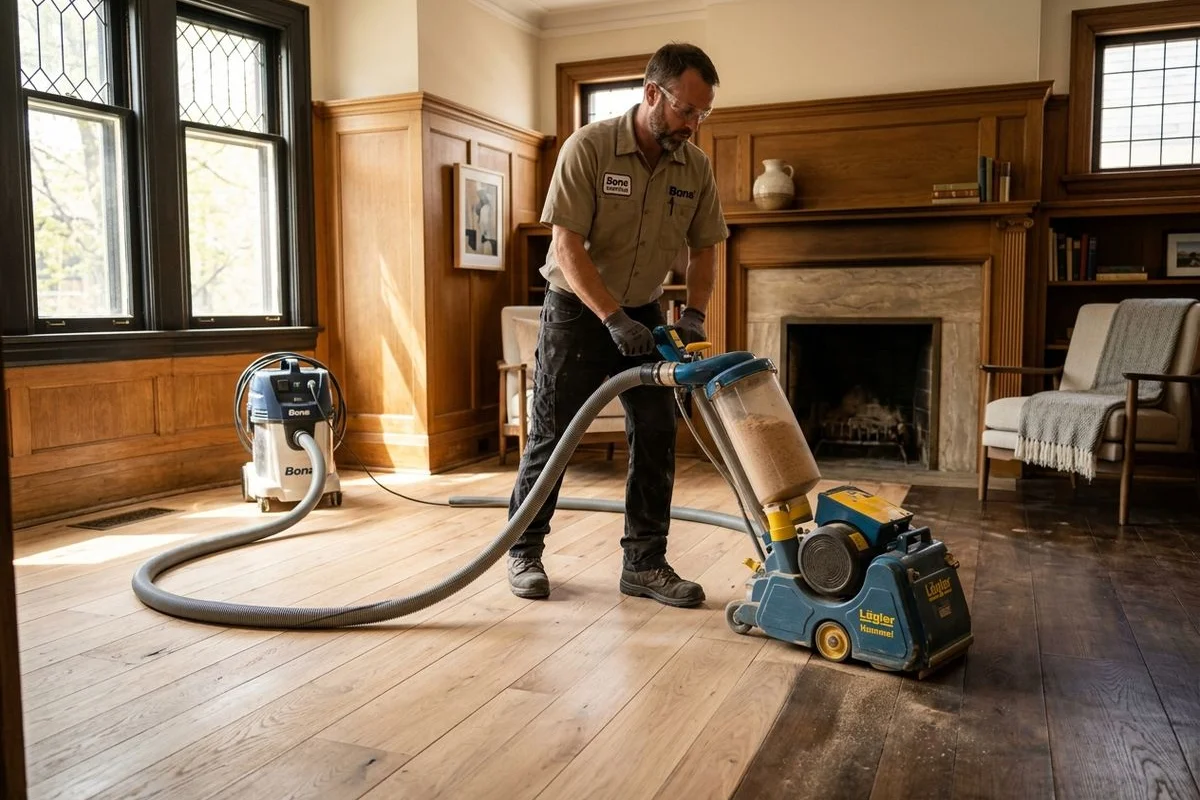
Factory-finished hardwood arrives with a UV-cured finish applied in controlled conditions. It performs adequately but has one limitation: the finish is applied before the boards are sanded flat as an assembled floor. Micro-bevels between boards are a factory-finish artefact designed to hide the inevitable height variation. A site-finished floor is sanded after installation with the full Bona grit sequence (36-60-80-100-120) using the Bona DCS dustless containment system, creating a single flat plane before any finish is applied.
The result is a floor with no micro-bevels, no visible joint height variation, and a finish matched exactly to your stain and sheen specification. Bona Traffic HD waterborne polyurethane is the standard finish for most Toronto residential installations: 24-hour sock-walk cure, 72-hour furniture, full cure at 7 days. Rubio Monocoat 2C hardwax oil is available for clients who prefer a natural-looking, low-sheen penetrating finish - particularly appropriate for White Oak and heritage species.
Cost Breakdown for Toronto Hardwood Installation
Most Toronto hardwood floor installation quotes include material, installation labour, site-finishing labour, stair nosing and threshold installation, and subfloor preparation up to a defined scope. The following ranges apply to 2026 Toronto residential projects.
| Species / Format | Installed and Site-Finished | Notes |
|---|---|---|
| 2.25” Red Oak strip, natural finish | $8-$11/sq ft | Most economical nail-down option |
| 3.25” Red or White Oak, custom stain | $11-$14/sq ft | Most common Toronto main-floor spec |
| 4”-5” White Oak wide plank, Rubio Monocoat | $14-$18/sq ft | Quartersawn for stability adds 15-20% |
| Hard Maple, natural Bona Traffic HD | $10-$13/sq ft | Commercial or high-traffic residential |
| Subfloor preparation (per sq ft) | $1.50-$4/sq ft | Grinding, shimming, squeaks |
Toronto Neighbourhoods We Install In
We install hardwood floors across Toronto and the GTA including Rosedale, Forest Hill, Bedford Park, Lawrence Manor, the Annex, Leaside, Davisville, Lytton Park, Cabbagetown, Riverdale, North York, Etobicoke, Scarborough, Mississauga, Brampton, Vaughan, Markham, Richmond Hill, and Oakville. Free in-home estimates throughout the GTA with no travel charge.
Related Questions Toronto Homeowners Ask
Can I install hardwood floors on top of existing flooring?
In some cases, yes. If the existing floor is securely bonded to the subfloor and the additional height does not create issues at doorways and transitions, new hardwood can be installed directly over existing ceramic tile, vinyl, or old hardwood. The existing floor must be flat to 3/16” over 6’. Adding height with a second layer of flooring reduces the door clearance and may require door trimming. We assess feasibility during the in-home estimate.
What causes hardwood floors to squeak after installation?
Squeaks after installation almost always originate at the subfloor level, not in the hardwood boards themselves. The most common causes are subfloor panels not fully fastened to joists (the panel flexes under load and rubs against the fastener), joists that have dried and shrunk away from the subfloor, or high spots that cause the hardwood to flex over a hump rather than lying flat. We address subfloor squeaks before installation - not after.
How do I maintain a site-finished hardwood floor in Toronto?
For Bona Traffic HD finishes, clean with Bona Hardwood Floor Cleaner - a pH-neutral spray applied with a microfibre mop. Do not use steam mops, excessive water, or oil soaps. Maintain indoor relative humidity between 35% and 55% year-round. A whole-home humidifier running October to April is strongly recommended for Toronto winters. For Rubio Monocoat finishes, use Rubio Surface Care spray and refresh with Rubio Monocoat Refresh annually in high-traffic areas.
Is hardwood flooring suitable for Toronto basements?
Below-grade installation of solid nail-down hardwood is not recommended due to the moisture risk. Concrete slab moisture levels below grade in Toronto frequently exceed the 75% relative humidity threshold that hardwood requires. Engineered hardwood with a glue-down installation on a properly moisture-tested slab - confirmed with ASTM F2170 RH probes - is the standard approach for finished Toronto basements where hardwood appearance is desired.
Installation - What's Included
- Red Oak, White Oak, Maple, and Douglas Fir in 2.25"-5" widths
- 18-gauge cleat nail-down on 3/4" plywood subfloor
- 3-5 day acclimation at finished temperature and RH
- Subfloor flatness to 3/16" over 6' before installation
- Full grit sequence site-finish (36-120) with Bona DCS
- Bona Traffic HD waterborne or Rubio Monocoat 2C hardwax oil
- Stair nosing, transitions, and threshold installation included
- NWFA installation standards on every project
Installation Pricing
All projects priced after a free in-home estimate. Written fixed-price quote within 48 hours - no surprises.
Why Toronto Homeowners Trust Us for Installation
NWFA Standards on Every Project
We follow National Wood Flooring Association installation guidelines for acclimation, subfloor prep, and fastener spacing on every residential and commercial project.
Species Knowledge
Red Oak, White Oak, Hard Maple, Walnut, and Douglas Fir each behave differently. We match species to your traffic load, humidity range, and design aesthetic.
Site-Finish Quality
Factory finish cannot be sanded flat on-site. Our full grit sequence site-finish delivers a furniture-grade surface matched precisely to your stain and sheen preference.
Honest Subfloor Assessment
If the subfloor cannot support nail-down hardwood, we tell you before any material is ordered. Glue-down on concrete and floating engineered options discussed at the estimate.
Our Installation Process
Site Assessment
We inspect subfloor flatness, moisture content, and joist spacing. Subfloor must read within 3 points of the wood's equilibrium moisture content before acclimation begins.
Acclimation
Hardwood acclimated on-site for 3-5 days at finished temperature (18-22°C) and relative humidity (35-55%). Boards stickered for air circulation.
Subfloor Preparation
High spots ground down, low spots shimmed or filled. Squeaks fastened before installation. Flatness confirmed to 3/16" over 6' with a straightedge.
Installation
Centre datum layout for symmetric plank widths at both walls. 18-gauge cleat nails on 8" centres. Blind nailing throughout field; face nailing within 12" of walls.
Site Finishing
Full grit sequence 36-60-80-100-120 with Bona DCS. Custom stain or natural. Two to three coats Bona Traffic HD or Rubio Monocoat 2C.
Ready for a free in-home estimate?
Fixed-price written quote within 48 hours. No surprises. No high-pressure calls.
What Customers Say About Our Installation
★★★★★"New solid White Oak throughout the main floor of our Forest Hill home. Nail-down on 3/4" plywood, site-finished in a custom mid-tone stain with Bona Traffic HD. Acclimated for 4 days before install. The centred datum layout meant the plank widths were symmetric at both walls. Exactly what we wanted."
★★★★★"1,400 sq ft of 3.25" Red Oak nail-down in our North York bungalow. Subfloor was levelled first - two high spots ground down. Site-finished natural with Bona Traffic HD. Light foot traffic in 24 hours as promised."
Installation FAQs
What subfloor do I need for hardwood floor installation?
Nail-down solid hardwood requires a minimum 3/4" plywood subfloor on joists spaced no more than 16" on centre. The subfloor must be flat to 3/16" over 6' and dry - within 3 points of the wood's equilibrium moisture content. Concrete subfloors require engineered hardwood with glue-down installation using Bona R848 adhesive. Floating click-lock installation is available for engineered hardwood and LVP over any stable substrate.
How long does hardwood floor installation take in Toronto?
Allow 3-5 days acclimation plus 1-2 days installation per 500 sq ft plus 4-5 days site-finishing. A typical 800 sq ft Toronto main floor runs 7-14 days total from first delivery to finished floor with walk-on cure. The acclimation period cannot be shortened without risking cupping, gapping, or finish adhesion failure after installation.
What is the difference between nail-down and glue-down installation?
Nail-down uses 18-gauge cleat nails into a plywood subfloor and is the correct method for solid hardwood. Glue-down with Bona R848 adhesive is required when the subfloor is a concrete slab - solid hardwood cannot be nail-down on concrete. Floating click-lock is suitable for engineered hardwood and LVP but does not produce the same solid feel underfoot as a nail-down or glue-down installation.
How much does hardwood floor installation cost in Toronto in 2026?
Toronto hardwood floor installation runs $8 to $18 per square foot installed and site-finished in 2026. The range reflects species selection (Red Oak at the lower end, hand-scraped wide-plank Walnut at the upper end), subfloor preparation scope, and finish complexity. A 600 sq ft main floor in Red Oak typically lands between $5,000 and $8,000 complete. Free fixed-price estimates after in-home site inspection.
More Toronto Hardwood Flooring Services
Ready to Book Installation?
Twenty years of Toronto craftsmanship. Bona Certified. Fixed-price written quote within 48 hours of the in-home visit.
Get Your Free Estimate Call 647-905-0255