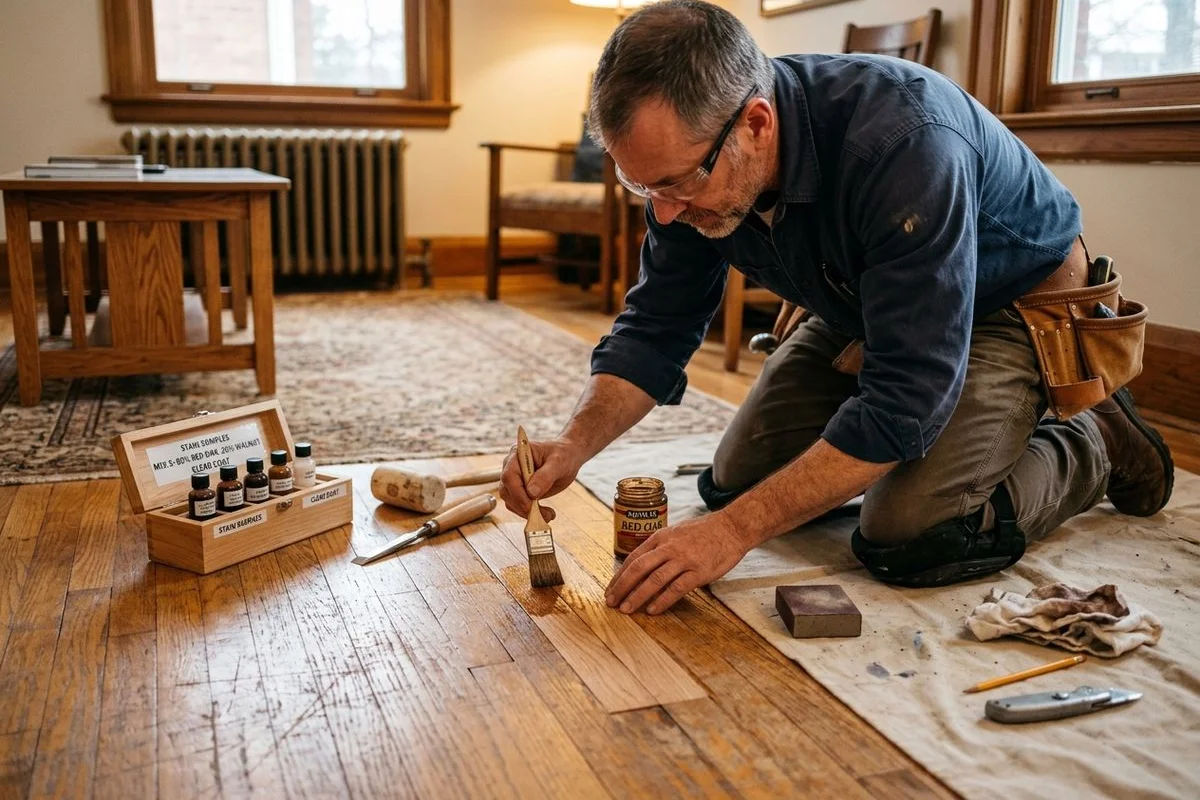
Water-Damaged Wood Floor Repair in Toronto, ON - Cupping, Staining and Board Replacement
Toronto Quality Wood Flooring diagnoses and repairs water-damaged hardwood floors throughout Toronto, North York, Etobicoke, Scarborough, Mississauga, Brampton, Vaughan, Markham, Richmond Hill, and Oakville. We use a Wagner MMC220 pin moisture metre on every assessment - testing both the hardwood boards and the subfloor beneath - and an ASTM F2170 in-situ RH probe for concrete slab moisture investigations. No repair work begins before the moisture source is confirmed and fixed.
Common Toronto water damage scenarios include cupping from slab moisture in Etobicoke ground-floor units, plumbing leak cupping from dishwasher or refrigerator water-line failures in North York and Scarborough, iron-tannate black staining in Red Oak floors from standing water after Rosedale basement window leaks, and structural delamination in Mississauga condominiums with balcony water ingress. Each damage type has a specific repair pathway; we assess and quote accurately after the in-home inspection.
Toronto Quality Wood Flooring provides water-damaged wood floor repair in Toronto, ON and surrounding communities, including North York, Etobicoke, Scarborough, Mississauga, Brampton, Vaughan, Markham, Richmond Hill, and Oakville.
Water-damaged hardwood floor repair in Toronto starts with moisture diagnosis before any repair work begins - Wagner MMC220 moisture metre testing, ASTM F2170 RH probe assessment for concrete slabs, and source remediation before sanding, replacing, or bleaching any boards, serving Etobicoke, Rosedale, North York, Leaside, and all of the GTA.
Three common mistakes define how not to handle water-damaged hardwood in Toronto. The first is sanding a cupped floor before the moisture source is fixed - the cups come back within weeks. The second is replacing boards when oxalic acid bleach treatment would have removed the staining without replacement. The third is skipping the moisture diagnostic entirely and quoting cosmetic repair on a floor with an active slab moisture problem. All three produce callbacks. A correct water damage repair starts with the metre, confirms the source, waits for the drying period, and then - and only then - executes the repair.
Types of Water Damage in Toronto Hardwood Floors
Toronto hardwood flooring water damage presents in five distinct patterns, each with a different cause, diagnosis, and repair pathway. Identifying the correct pattern before any repair begins determines whether the outcome is a durable fix or a temporary cosmetic patch.
Cupping - Moisture from Below
Cupping is the most common water damage pattern in Toronto. The board edges lift higher than the board centre, creating a slight concave face across each plank. The cause is always moisture differential between the bottom face and top face of the board: the bottom is wetter than the top, so it expands more than the top, pushing the edges up.
Sources of below-floor moisture in Toronto homes include:
- Slab-on-grade concrete - Ground-floor Etobicoke condominiums and Scarborough bungalows on slab often have inadequate vapour barriers between the concrete and the subfloor. Seasonal groundwater rises or a failure in the vapour retarder allows moisture to migrate up through the slab, through the subfloor, and into the hardwood boards. ASTM F2170 in-situ RH probe testing is the only reliable method for diagnosing slab moisture - a pin metre reading at the wood surface will not detect slab moisture that has not yet fully migrated to the board faces.
- Plumbing leaks below the subfloor - Dishwasher drain line failures, refrigerator water-line leaks, and bathroom supply line pinhole leaks are the most common causes of cupping in North York and Etobicoke detached homes. The leak runs into the subfloor cavity and saturates the bottom face of the hardwood from below. The floor shows no surface water - homeowners are often unaware there is a leak until the cupping appears.
- Basement condensation - An uninsulated or poorly insulated basement ceiling in a Rosedale Victorian or Forest Hill semi-detached allows condensation to form on the subfloor bottom during Toronto summers when warm, humid outside air contacts the cooler basement ceiling. This condensation drips onto the basement floor but also migrates into the subfloor wood and upward.
Crowning - Moisture from Above
Crowning is the opposite of cupping: the board centre is higher than the board edges. It occurs when the top face of the board absorbs water and swells, or - more often in Toronto - when a cupped floor is sanded prematurely while still wet. Sanding a cupped floor removes the raised edges and makes the floor visually flat, but as the boards continue to dry and the bottom face contracts, the board centres that were not sanded rise above the newly lowered edges.
Crowning from premature sanding requires either waiting for the floor to re-stabilise (which may take 6-12 months in Toronto’s seasonal humidity cycle) or full replacement of the affected section.
Iron-Tannate Black Staining in Oak
Black staining in Red Oak hardwood floors is one of the most alarming-looking water damage presentations - and one of the most treatable. The chemistry is straightforward: Oak species contain significant concentrations of tannic acid. When iron-containing water contacts Oak, the tannic acid reacts with dissolved iron to form iron tannate, a dark pigment historically used as ink and now visible as a black-to-grey stain in the wood grain.
Sources in Toronto homes include corroded cast iron pipes (Rosedale and Cabbagetown homes built before 1950 often retain original cast iron plumbing), galvanised steel subfloor fasteners that corrode with moisture, and standing water from any source that contacts iron fixtures or fasteners before pooling on the floor.
Treatment requires sanding to bare wood at the stain location, applying a saturated oxalic acid (wood bleach) solution, allowing adequate dwell time for the chemical reaction to reverse the iron-tannate bond, neutralising, drying, and refinishing. Most surface and mid-depth iron-tannate stains respond completely to this treatment. Deep stains that have penetrated the full board thickness after weeks of water contact require board replacement.
| Stain Type | Cause | Treatment | Replace Required? |
|---|---|---|---|
| Black (iron-tannate) | Iron in water + Oak tannins | Oxalic acid bleach | Only if through-thickness |
| White or grey (surface) | Moisture trapped under finish | Sand and refinish | Rarely |
| Dark grey/brown (deep) | Extended water contact | Sand + oxalic acid or replace | If penetration exceeds 4mm |
| Structural softness/rot | Long-duration saturation | Board replacement only | Always |
White Staining in the Finish Surface
White or cloudy patches in a polyurethane finish surface are caused by moisture trapped between the finish layer and the wood - typically from steam mopping, over-wet cleaning, or water left standing on the floor. The finish itself has delaminated at the micro level, trapping air or moisture below. White staining in the finish only (not in the wood) is treated by screening the affected area and applying a fresh topcoat. If the staining has penetrated into the wood, spot refinishing to bare wood and re-coating is required.
Structural Delamination and Rot
Extended water contact - weeks to months - causes engineered hardwood to delaminate at the core plies and solid hardwood to begin biological decay. Boards in this state are soft to the touch, may crumble at the edges, and have completely lost structural integrity. Replacement is the only option. Subfloor damage in these cases is common and must be addressed before any new hardwood is installed.
Toronto-Specific Moisture Scenarios
Toronto’s housing stock creates specific water damage patterns by neighbourhood and era of construction.
Etobicoke slab-on-grade bungalows (1950s-1970s) frequently have inadequate vapour barriers between the concrete slab and the wood subfloor. Hardwood installed directly over plywood on these slabs shows cupping after 5-15 years as the barrier degrades. Diagnosis requires ASTM F2170 RH probe testing, not a surface moisture metre reading.
Rosedale and Cabbagetown Victorian semi-detached homes are susceptible to exterior wall moisture migration in masonry walls that are not properly waterproofed or where the parging has cracked. The moisture migrates inward to the subfloor and appears as cupping in the first floor boards adjacent to exterior walls.
North York and Scarborough detached homes most commonly present with dishwasher and refrigerator water-line failures. These appliances account for the majority of insurance claims for water damage in Toronto detached housing built between 1960 and 1990.
Leaside and Forest Hill renovated homes frequently show cupping caused by new HVAC systems that significantly change the house’s humidity profile. A new forced-air furnace in a recently renovated Leaside home may reduce winter RH from 35% to under 20%, causing boards to gap and spring upward at the edges as they dry.
The Diagnosis Process
Every water-damaged floor assessment begins with the Wagner MMC220 pin moisture metre. We test at minimum ten locations across the affected area - both in the wood and, where possible, in the subfloor at accessible edges. Readings above 12% MC in Red Oak indicate elevated moisture; readings above 15% indicate active moisture ingress that has not yet reached equilibrium. For slabs, we install ASTM F2170 in-situ RH probes per the testing standard - drilled into the concrete at the specified depth and sealed for the prescribed dwell time - because a surface metre reading on a slab is not a reliable indicator of the vapour drive that causes subfloor and hardwood moisture loading.
The moisture source is identified and fixed before any repair scope is quoted. This is non-negotiable. A board replacement on a floor with an unresolved slab moisture problem will cup again within a season.
Related Questions Toronto Homeowners Ask
How long does it take cupped hardwood floors to flatten after fixing the moisture source?
The drying timeline depends on how long the boards were wet, the severity of the cupping, and the relative humidity management after source remediation. Minor cupping (under 2mm) in boards that were wet for less than two weeks typically resolves in 30-60 days with proper dehumidification maintaining 40-50% RH. Significant cupping (3-5mm) after extended moisture exposure may take 90-120 days to stabilise. We schedule a follow-up assessment at 60 days after source remediation - if the boards have returned to within 1mm of flat, we proceed with sanding. If not, we extend the monitoring period.
Will my insurance cover water-damaged hardwood floor repair in Toronto?
Most Toronto home insurance policies cover water damage from sudden and accidental events - burst pipes, appliance failures, and sewage backup (with the sewage backup rider). Gradual seepage, slab moisture, and maintenance-related deterioration are typically excluded. We provide a detailed written assessment report with moisture readings and damage documentation that your insurer will require for the claim. We have worked with most major Canadian insurers on Toronto floor claims and can advise on what the assessment report needs to include.
Can engineered hardwood be repaired after water damage, or does it always need replacement?
Engineered hardwood is more susceptible to permanent damage from water than solid hardwood because the cross-ply construction traps moisture between layers, causing the plies to delaminate when wet. Boards that were wet for under 24 hours and have been quickly dried with air movers often survive without delamination. Boards with visible swelling, bubbling face veneer, or softness at the edges have delaminated and require replacement. Because engineered hardwood is not sanded to bare wood in most cases, chemical stain treatment is not always possible - colour staining in engineered floors often requires face-veneer sanding to the maximum allowed by the wear-layer thickness.
Water Damage - What's Included
- Wagner MMC220 pin moisture metre on every assessment
- ASTM F2170 RH probe for concrete slab moisture diagnosis
- Moisture source identification before any repair begins
- Cupping assessment - 60-90 day monitoring after source fix
- Oxalic acid bleach treatment for iron-tannate black stains in Oak
- Board-for-board replacement matched to existing species and width
- Bona DriFast stain matching for replaced or repaired boards
- Bona Traffic HD or Rubio Monocoat 2C finish match to adjacent floor
Water Damage Pricing
All projects priced after a free in-home estimate. Written fixed-price quote within 48 hours - no surprises.
Why Toronto Homeowners Trust Us for Water Damage
Moisture Source First - Always
We will not quote a repair on a wet floor. The moisture source must be identified and fixed before any board replacement or sanding begins. This is non-negotiable because repairing over an active moisture source fails within months.
Wagner MMC220 on Every Visit
Moisture metre testing on both the hardwood and the subfloor on every assessment visit - not a visual estimate. We bring data to the diagnostic, not guesswork.
Honest Cupping Assessment
Cupped floors frequently return to flat after moisture source remediation and a 60-90 day drying period. We wait rather than replace boards prematurely. The patience saves clients thousands.
Chemical Stain Treatment
Black iron-tannate stains in Oak can be treated with oxalic acid bleach without board replacement in many cases. We attempt chemical treatment before recommending replacement.
Our Water Damage Process
Moisture Diagnosis
Wagner MMC220 pin metre testing on hardwood boards and subfloor. ASTM F2170 RH probe for slab projects. Identify moisture source - plumbing, slab, exterior, or HVAC.
Source Remediation
Moisture source must be fixed before repair. We coordinate with plumbers, waterproofers, or HVAC contractors. No repair quote proceeds until the source is confirmed resolved.
Monitoring Period
For cupped floors: 60-90 day monitoring period with dehumidifier after source fix. Boards that return to flat can often be sanded rather than replaced.
Repair Execution
Stain treatment for black or white staining. Board replacement for irreparable sections. Full grit sequence sand-and-finish or spot refinish to match the adjacent floor.
Ready for a free in-home estimate?
Fixed-price written quote within 48 hours. No surprises. No high-pressure calls.
What Customers Say About Our Water Damage
★★★★★"Four boards cupping in our living room and three other companies quoted us a full sand. These guys brought a Wagner moisture metre, found the slab reading was out of spec, and told us to fix the source before touching the floor. Six weeks with a dehumidifier, the cups came down on their own, and they did a spot repair instead of a $4,000 refinish."
★★★★★"Dishwasher slow leak over 6 months. Black iron staining across 4 Oak boards near the kitchen. Oxalic acid bleach treatment, waited 48 hours, stain matched with Bona DriFast, and 2 boards replaced where the damage was through the full thickness. Can't tell where the repair is."
Water Damage FAQs
Can cupped hardwood floors be fixed without replacement?
Often yes, if the moisture source is fixed first. The repair pathway for cupped boards is: fix the source, maintain 40-50% RH with dehumidification for 60-90 days, then reassess. Cupping under 3mm that resolves after moisture correction can usually be sanded flat in a standard refinishing. Persistent cupping over 4mm after 90 days of correct RH management, or cupping that has progressed to structural board damage, typically requires board replacement. We never quote a sand on a floor before the moisture source is fixed and the boards have had time to stabilise.
How do you fix black water stains on hardwood floors?
Black stains in Oak are iron tannate - a chemical reaction between Oak tannins and the iron content of water. The treatment is: sand to bare wood at the stain location, apply a saturated oxalic acid solution, allow 4-8 hours dwell time, neutralise with a baking soda and water wash, allow 48 hours to dry completely, then stain and refinish to match the adjacent floor. This treatment removes most iron-tannate stains entirely. Stains that have penetrated the full board thickness after extended water contact - typically over 4mm deep - require board replacement because the chemical reaction has oxidised the wood throughout its thickness.
How do I know if my floor is cupped from moisture underneath or from water on top?
Cupping (board edges higher than the board centre) indicates moisture entering from below - the underside of the board is wetter than the face, causing the wood to expand from the bottom up. The source is almost always slab moisture, groundwater, a plumbing leak below the subfloor, or an improperly vapour-sealed basement. Crowning (board centre higher than the edges) indicates the opposite - moisture entered from the top surface, was absorbed, then the top dried while the bottom remained wet. Crowning often occurs after a flood is cleaned up and the floor dries non-uniformly, or after sanding a cupped floor prematurely before it has dried.
Our floor flooded from a burst pipe - what do we do?
First priority is water extraction and drying, not floor repair. Call a water damage restoration company immediately for wet vacuuming, air movers, and dehumidifiers. Do not wait. The faster the floor is dried, the higher the probability of saving it. Once the restoration company confirms the floor and subfloor are at target moisture content, contact us for a repair assessment. Boards dried within 24-48 hours of flooding frequently survive. Boards wet for 72 hours or more often require replacement. We provide the repair assessment; the water damage restoration is a prerequisite.
More Toronto Hardwood Flooring Services
Ready to Book Water Damage?
Twenty years of Toronto craftsmanship. Bona Certified. Fixed-price written quote within 48 hours of the in-home visit.
Get Your Free Estimate Call 647-905-0255