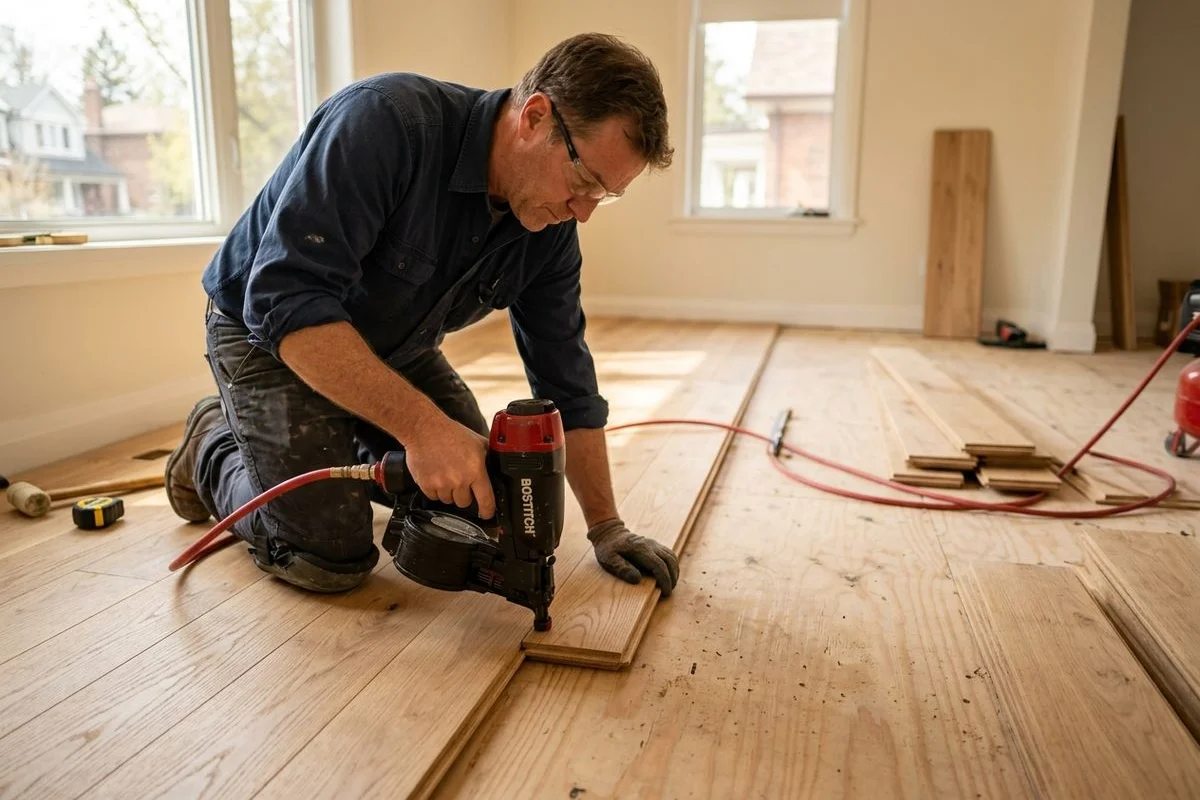
Planning around a hardwood staircase installation - what the timeline actually looks like
Hardwood staircase installation in Toronto involves more steps than most homeowners expect from looking at the finished product. The visible work - fitting treads, nailing them into place, applying finish - represents roughly half the total project time. The other half is preparation, acclimation, and cure time that happens before and after the visible installation day.
Understanding the full timeline before booking lets you plan access to upper floors, coordinate around other trades (painters, cabinet installers), and set accurate expectations for when the staircase will be fully usable.
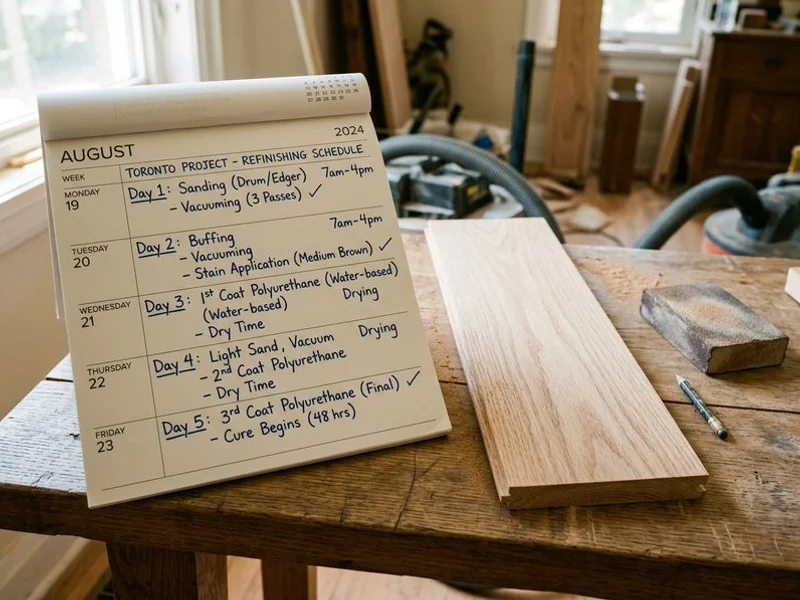
Step 1: Acclimation (24-48 hours before installation day)
Hardwood stair treads must acclimate to the ambient conditions of the home before installation. Tread blanks brought from a warehouse into a heated Toronto home in winter, or a cooled home in summer, need time to stabilise before they are cut and fitted. Installing without acclimation risks movement after the tread is nailed down - gaps at the nosing, squeaks at tread-to-riser joints, or cupping on wide treads.
- Standard 3/4-inch tread blanks: 24-48 hours acclimation in the installation space
- Thick tread stock (1-3/4 inch, used for open-riser floating staircases): 48-72 hours
- HVAC must run at normal occupancy settings during acclimation - do not reduce heat or air conditioning to save energy during this window
Acclimation happens in the room where the staircase is located, with material stacked loosely to allow air circulation. The moisture content of the tread stock is checked with a calibrated meter at the end of the acclimation period and compared against the subfloor or stringer reading.
Step 2: Preparation and carpet removal (2-6 hours)
For staircases converting from carpet to hardwood, carpet removal and surface preparation happen on installation day (morning), before any hardwood material is fitted.
- Carpet, padding, and tack strips are removed from each tread and riser
- Staples and tack strip nails are pulled from the tread surface - each staple left in place can telegraph through a hardwood tread over time
- Tread surfaces are checked for rot, softness, and structural soundness. Damaged tread substrates are sistered or replaced before hardwood is fitted
- Stringer and riser surfaces are examined for squeak sources and fastened more securely if needed
This phase takes 2-3 hours on a standard 14-tread straight staircase. A staircase with extensive carpet adhesive residue, buried tack strips, or subfloor damage under carpet can take 4-6 hours before tread fitting begins.
Step 3: Installation - time by staircase type
Installation pace depends on configuration, species, and whether the project is tread-only capping or full tread-and-riser replacement.
| Staircase Type | Tread Count | Installation Time | Finish Time | Total Project Window |
|---|---|---|---|---|
| Straight staircase, tread capping | 12-14 treads | 1 day | 1-2 days (2 finish coats) | 3-4 days including acclimation |
| Straight staircase, full replacement | 12-14 treads | 1-2 days | 1-2 days (2 finish coats) | 4-5 days including acclimation |
| Staircase with landing | 18-22 treads + landing | 2-3 days | 2 days (2 finish coats) | 5-6 days including acclimation |
| Curved or custom staircase | 12-18 treads | 3-5 days | 2-3 days (2-3 finish coats) | 6-9 days including acclimation |
A two-person crew working a straight 14-tread staircase with tread capping - carpet removal in the morning, treads fitted and glued or nailed through the afternoon - can complete the mechanical installation in a single day. Full tread-and-riser replacement on the same staircase takes an additional half-day to a full day because risers are individually fitted and the sequence of tread and riser installation requires a precise order to avoid trapping the crew above a wet adhesive.
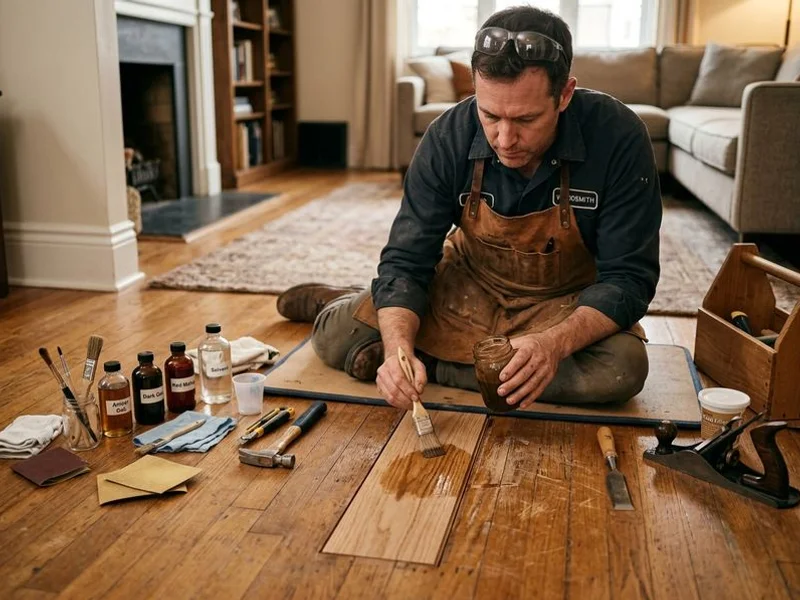
What happens each day of a typical project
Day 0 (evening before or morning of Day 1): Tread material delivered and acclimation begins. If the staircase is converting from carpet, this is often when carpet is stripped so the tread surfaces can air out overnight.
Day 1 - Preparation and installation: Carpet removal complete by mid-morning. Tread surfaces prepared, stringer checked, any subfloor repairs addressed. Tread fitting and installation begins. On a 14-tread straight staircase, installation is substantially complete by end of Day 1.
Day 2 - Completion and first finish coat: Any remaining treads fitted. Nosing profiles sanded and edges cleaned. First coat of Bona Traffic HD applied to all treads. Walk-safe after 3-4 hours, but no foot traffic on treads on Day 2 after coating.
Day 3 - Second finish coat: Light abrasion of Day 2 coat. Second coat of Bona Traffic HD applied. Walk-safe in clean socks 24 hours after this coat (Day 4 morning).
For site-finished projects with a custom stain, add one additional day between the surface preparation and the first finish coat: stain is applied on Day 2 and allowed to cure overnight, and the first seal coat goes on Day 3.
Step 4: Cure time and return to full use
Bona Traffic HD, the standard waterborne finish used on Toronto staircase projects, reaches initial hardness quickly but achieves full chemical cure over 7-14 days.
- 24 hours after final coat: Clean socks only - no shoes
- 48 hours: Shoes safe, normal foot traffic
- 72 hours: Children and pets in normal use
- 14 days: Full cure - stair runners and carpet stair treads can be installed, and any furniture placed at the landing or base of the stair can be moved into final position
Using a staircase before the 48-hour threshold with shoes or work boots will leave scuff marks in the partially cured finish. These cannot be buffed out without a full recoat of the affected treads.
What causes delays
Several site conditions extend a staircase project beyond the standard timeline:
- Custom nosing profile: Standard bullnose nosing is cut as part of the tread installation. Ogee, waterfall, or square-edge custom profiles require router setup and a test pass before all treads are profiled - this adds 2-3 hours on a standard staircase.
- Iron baluster removal and reinstallation: Metal balusters take 30-60 minutes per baluster compared to 10-15 minutes for wood. A staircase with 36 iron balusters can add 6-8 hours to the removal and reinstallation sequence.
- Subfloor damage under carpet: Soft spots, rot, or excessively uneven tread surfaces discovered under carpet removal require repair before tread installation can proceed. Depending on severity, this adds 2-8 hours.
- Stain sample approval: If a custom stain colour is specified, samples are applied to actual tread material and allowed to dry before approval. If the first sample is not approved, an additional day is required for each new sample round.
- Spindle removal causing damage: Older staircases sometimes have balusters glued directly into the tread. Removal can damage the tread surface, requiring additional surface preparation before the new hardwood is fitted.
How to plan your household around the installation
Stair access is restricted during installation and for the first 24-48 hours after the final finish coat. For homes with upper-floor bedrooms, plan for:
- Any items needed from upper floors to be moved down before Day 1
- An alternate sleeping arrangement if stairs will be completely inaccessible overnight (rare on straight staircases where the crew sequences top-to-bottom, but common on curved and floating stair projects)
- Children and pets either out of the home or contained to a single floor during the finish coat sequence
For complete detail on the project scope, species options, and what the installation process covers, see our hardwood staircase installation service page.
Toronto Quality Wood Flooring provides a free in-home estimate and a written fixed-price quote within 48 hours. The quote includes a calendar window for each project phase based on your specific staircase configuration and the subfloor conditions observed during the visit - so you can schedule trades, plan access, and coordinate move-in dates with an accurate timeline rather than a guess.