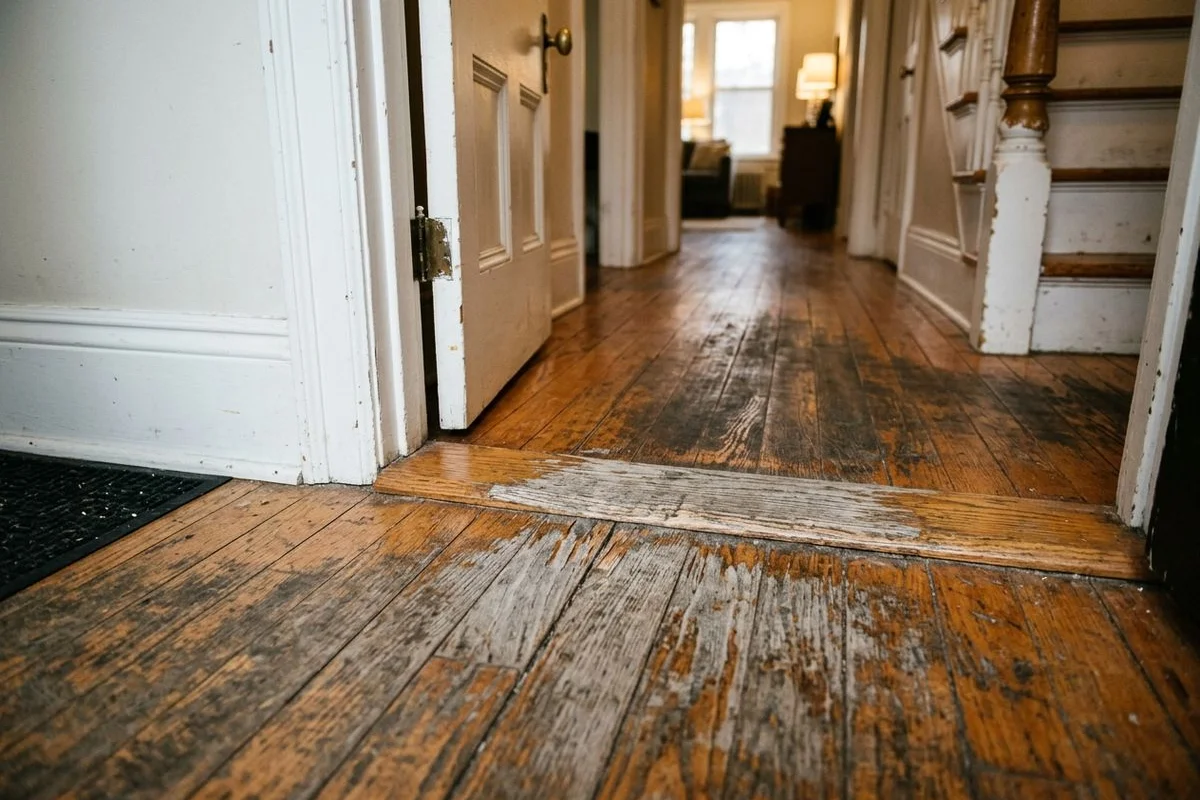
Why timing matters with hardwood floor recoating
The window for recoating is specific. Once a hardwood floor’s finish has worn completely through to bare wood, recoating is no longer an option - full drum sanding and refinishing becomes necessary. Catching the floor while the finish is still intact but visibly wearing means the difference between a $1.50-3/sq ft recoat and a $3-8/sq ft full refinish.
Most Toronto hardwood floors reach the recoating window between 3 and 7 years after a refinish, depending on foot traffic, pets, and maintenance habits. Knowing the signs allows you to act at the right time - before the more expensive intervention becomes necessary.
Sign 1: Dullness that does not respond to cleaning
The most common first sign is a floor that looks perpetually dull no matter how well it is cleaned. You mop, you dry it, and it still looks flat and worn rather than clean and shining.
This is different from a floor that is dirty - a dirty floor shows debris, smudges, and residue that lifts with cleaning. A floor with a worn finish looks washed out or flat even when completely clean and dry. Run your hand across the surface in a well-lit area: the worn finish looks chalk-like or grey-flat compared to areas at the room perimeter where finish wear is lighter.
This type of dullness indicates the top coat (or multiple top coats) of the finish have worn thin enough that the surface no longer reflects light cleanly. The floor is not dirty - the protective layer itself has worn down.
Recoating addresses this directly. A screen and recoat scuffs the remaining finish surface and applies a fresh coat of Bona Traffic HD or Bona Mega, restoring the reflective quality and protective depth of the finish layer.
Sign 2: Light surface scratches that do not catch a fingernail
Light scratches visible in the finish - fine lines from sand and grit tracked in from outside, hairline marks from furniture movement, or the general micro-scratching pattern of daily use - are a normal sign of finish wear.
The distinction that matters is whether the scratch is in the finish layer or through it to bare wood.
In-finish scratches: run a fingernail perpendicular to the scratch. If the nail glides over smoothly without catching, the scratch is in the finish surface. These scratches are recoatable - the buffer scuff removes the surface texture (including the scratch), and the fresh coats fill in and level the surface.
Through-finish scratches: if a fingernail catches in the scratch groove, the scratch has penetrated through the finish into the wood fibre beneath. These cannot be buffed out and will show through a recoat because the wood itself is damaged, not just the finish. Widespread through-finish scratching indicates the need for full refinishing.
A floor with mostly in-finish scratches and isolated deeper ones may still be a recoat candidate - the deeper scratches can sometimes be addressed with spot prep before the full recoat. A floor with widespread deep scratching throughout the traffic lanes typically needs full refinishing.
Sign 3: Finish wearing thin in traffic lanes with no bare wood
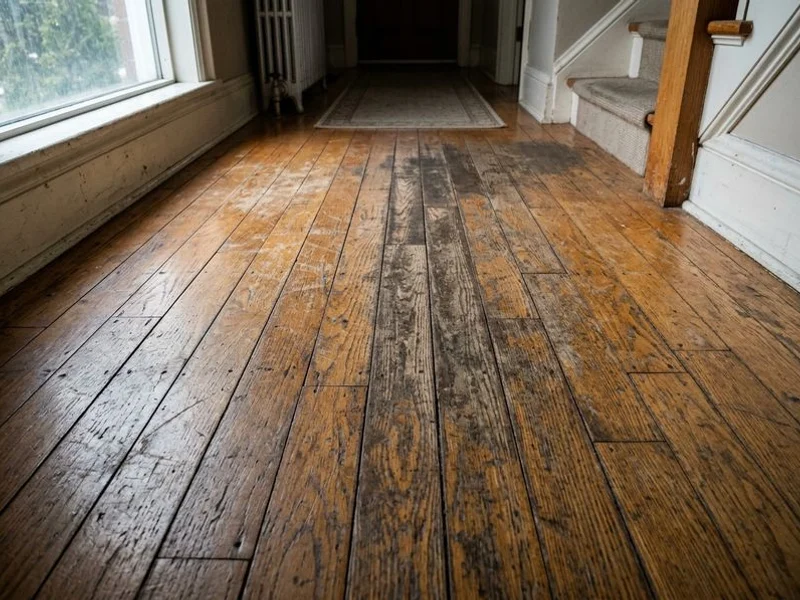
Traffic lanes - the paths between rooms, in front of sofas, from kitchen to dining area - carry far more wear than room perimeters or furniture-covered areas. Over time, the finish in these lanes wears noticeably faster than the rest of the floor.
You can see this as a path-shaped dull zone cutting through an otherwise shinier floor. Stand at one end of a hallway and look along the floor in raking light (angled low): the traffic lane appears flatter and less reflective than the edges near the baseboards.
This uneven wear pattern is the clearest visual signal that the floor is in the recoating window. The finish in the lanes is thinning but the wood beneath is not yet exposed. Recoating now - across the entire floor surface, not just the lanes - brings the full floor back to a uniform protective depth and extends the finish life significantly.
Do not wait until the lanes go bare. Once bare wood appears in the traffic lane, that area cannot be recoated and the full floor requires sanding.
Sign 4: Water spreads slowly rather than beading
The water bead test is the most reliable objective check for finish integrity.
How to do the test:
- Select the most worn area of the floor - a traffic lane, hallway, or area in front of a sofa.
- Pour one tablespoon of water onto the surface.
- Wait 60 seconds and observe the result.
Results and what they mean:
- Water beads into a distinct droplet - finish is intact. The floor is in good condition or early wear stage.
- Water spreads slightly but does not soak in - finish is thinning. This is the ideal recoating stage. The protective barrier is weakening but still functional.
- Water soaks in slowly (30-90 seconds) - finish is significantly worn. Recoating is still possible but should be scheduled promptly. Further delay risks crossing into bare wood territory.
- Water soaks in immediately - finish is gone in this area. Bare wood is exposed. Full refinishing is required.
Perform the test in at least three locations: the main traffic lane, a secondary traffic area, and a low-wear area near the wall. The lowest-performing result represents the floor’s true condition.
Sign 5: The floor looks clean but flat
The fifth sign is harder to describe but immediately recognisable once you know what to look for. A floor with a worn finish looks clean - you can wash it and it does not show residue or marks - but it has no depth or warmth. It looks flat, institutional, or washed out even when freshly cleaned.
This is because finish adds visual depth to wood, not just surface protection. A healthy finish coat refracts light down into the wood grain and back out, giving the floor its characteristic warmth and richness. When the finish wears thin, the wood appears closer to the surface visually - flat and one-dimensional rather than deep and lustrous.
If your floor passes the fingernail test, shows no bare wood in the water bead test, but has this flat visual quality, it is in the ideal recoating window. Two fresh coats restore the visual depth along with the physical protection.
The contamination disqualifier
One condition overrides all five signs above: contamination from oil-based cleaners or wax.
If the floor has been cleaned with Murphy Oil Soap, Mop&Glo, Orange Glo, any oil soap, or any paste or liquid wax, the surface carries a residue that prevents waterborne finish from bonding. A recoat applied over contaminated wood will delaminate - peel or flake off in high-traffic areas within weeks or months.
Products that contaminate and disqualify a floor from recoating:
- Murphy Oil Soap (and generic equivalents)
- Mop&Glo
- Orange Glo
- Pledge wood floor products
- Any paste wax or liquid wax
- Oil soap in any form
If you have used any of these products regularly on the floor, inform the service professional at the time of assessment. The pre-recoat evaluation includes a contamination test. If contamination is present, the correct scope is full sanding - not recoating.
How to clean hardwood properly between recoats: Use a pH-neutral, waterborne-finish-compatible cleaner like Bona Hardwood Floor Cleaner, applied via a barely damp mop. Never use steam mops, wet mops, or oil-based products on a finished hardwood floor.
When it is too late for recoating
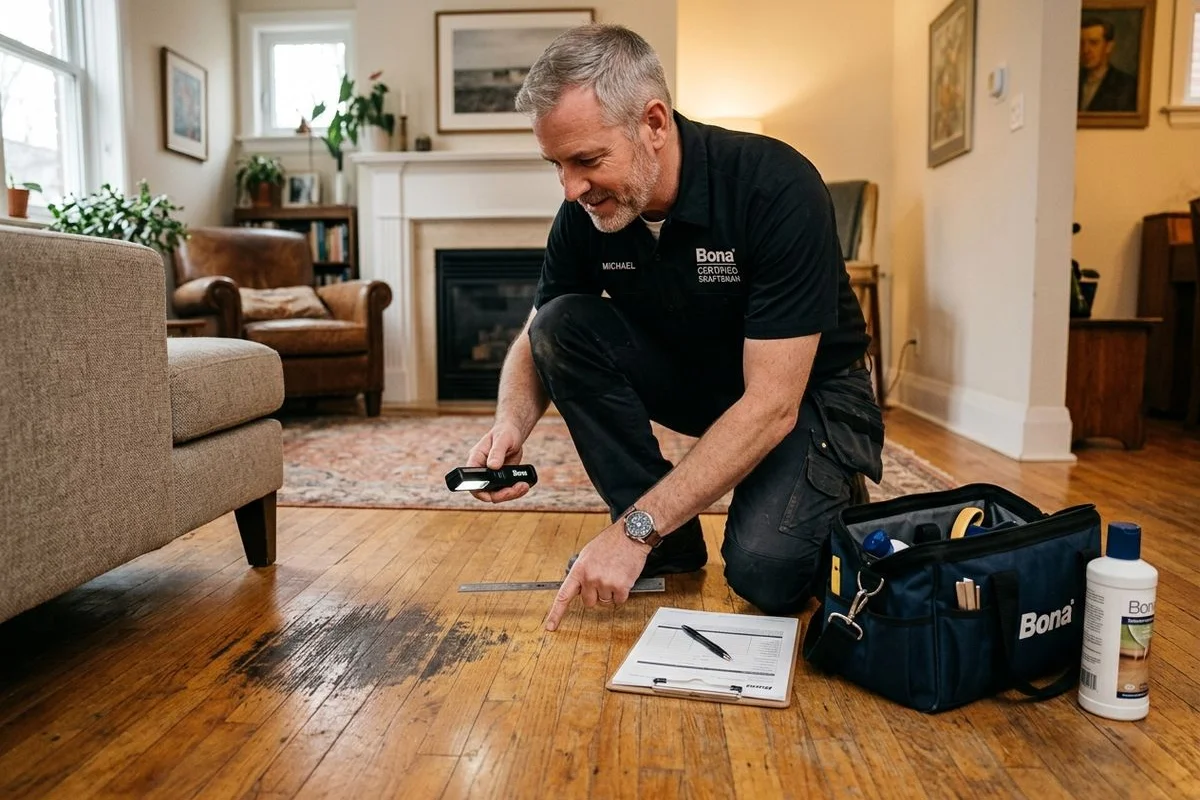
Several conditions indicate the floor has passed the recoating window:
- Bare wood is visible - any area where scratches show a lighter colour beneath the finish, or where the water bead test shows immediate absorption
- Black or grey staining in the grain - iron acetate reaction (from pet urine, moisture, and metal contact) or mould penetration that has gone below the finish surface
- Confirmed contamination - wax or oil-based cleaner residue throughout the floor
- Previous recoat is delaminating - peeling or flaking of a previous recoat coat, indicating the adhesion has already failed
In any of these cases, hardwood floor buffing and recoating is not the right scope - full drum sanding and refinishing addresses the underlying problem properly.
Ideal recoating frequency
| Use level | Example | Recommended recoat interval |
|---|---|---|
| Low traffic | Bedroom, formal dining room rarely used | Every 5-7 years |
| Moderate traffic | Living room, bedroom in family use | Every 3-5 years |
| High traffic | Open-plan main floor, hallway, home with dogs | Every 2-3 years |
| Commercial/rental | Office, retail, rental property | Every 1-2 years |
Scheduling recoats on a proactive cycle - before the floor shows significant wear - is more effective than waiting until wear is visible. A floor recoated at the 3-year mark on a moderate-traffic schedule stays consistently healthy; a floor allowed to wear to the 5-6 year point before first recoat may already be showing bare wood in high-use areas.
How to extend floor life between recoats
Three habits extend the time between recoats significantly:
Entrance mats at all entry points - sand, grit, and fine particles tracked in from outside are the primary cause of finish wear. A quality mat at every exterior entry captures the majority of abrasive particles before they reach the floor.
Felt pads on all furniture legs - bare wood or metal furniture feet create micro-scratches every time a chair or table is moved. Felt pads eliminate this. Replace felt pads when they wear flat (usually every 6-12 months depending on the furniture).
Compatible cleaning products only - use Bona Hardwood Floor Cleaner or equivalent pH-neutral, residue-free cleaner. Avoid all oil soaps, wax products, and steam mops. Excessive moisture is as damaging to the finish as abrasion.
Book your recoating assessment
Toronto Quality Wood Flooring performs free on-site recoating assessments across Toronto, North York, Scarborough, Etobicoke, and the surrounding GTA. The assessment covers the water bead test, scratch depth check, and contamination test - the three checks that determine whether your floor is in the recoating window or requires a different scope. If the floor passes, recoating can typically be scheduled within the week and completed in one day. Contact Toronto Quality Wood Flooring to book your free assessment.