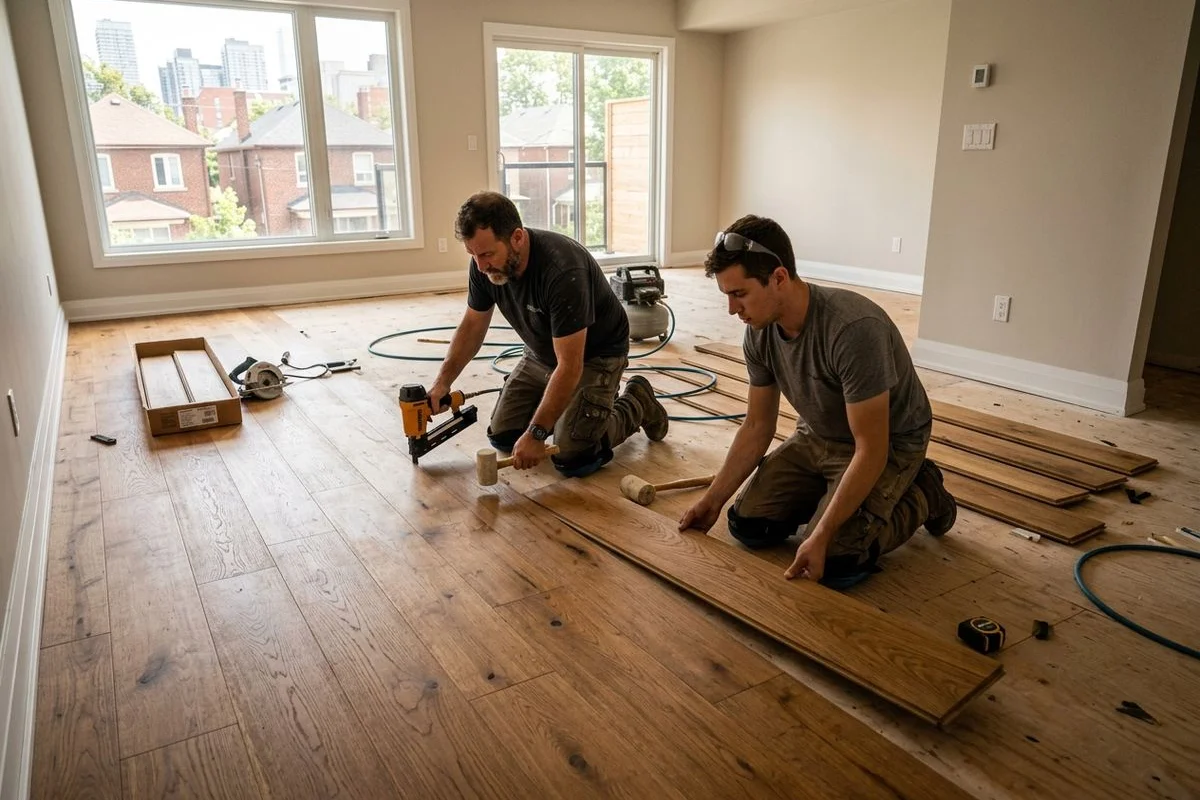
Choosing the best hardwood for high-traffic commercial use
The best hardwood floor for a high-traffic commercial space is not simply the hardest one available. Species hardness, construction method, plank geometry, and finish system all interact with your specific traffic type, subfloor, and scheduling constraints. A Hard Maple gym floor specification and a White Oak restaurant floor specification both qualify as commercial-grade - they are engineered for different conditions.
This guide uses Janka hardness ratings, Ontario market experience, and real commercial installation data to help you match the right product to your specific commercial environment.
For pricing and project scope, see our commercial hardwood flooring service page.
Understanding Janka hardness for commercial applications
Janka hardness measures the force required to embed a 0.444-inch steel ball to half its diameter in a wood sample. The test result is expressed in pounds-force (lbf). For commercial flooring selection, Janka hardness is the primary species comparison metric - it correlates directly with dent and scratch resistance under foot traffic.
| Species | Janka Hardness (lbf) | Commercial Application |
|---|---|---|
| Brazilian Walnut (Ipe) | 3,680 | Extreme traffic - entryways, industrial corridors |
| Santos Mahogany | 2,200 | Heavy retail, high-traffic commercial lobbies |
| Hard Maple | 1,450 | GTA gyms, school corridors, office floors |
| White Oak | 1,360 | Restaurants, high-end retail, corporate offices |
| Red Oak | 1,290 | Light-to-moderate commercial, private offices |
| American Walnut | 1,010 | Low-traffic commercial, executive spaces |
The Janka rating tells you dent resistance. It does not tell you stability, workability, or finish compatibility - all of which matter in a commercial installation. Red Oak at 1,290 lbf is perfectly adequate for a private accounting office. It is not the right specification for a school corridor that processes 800 students per day.
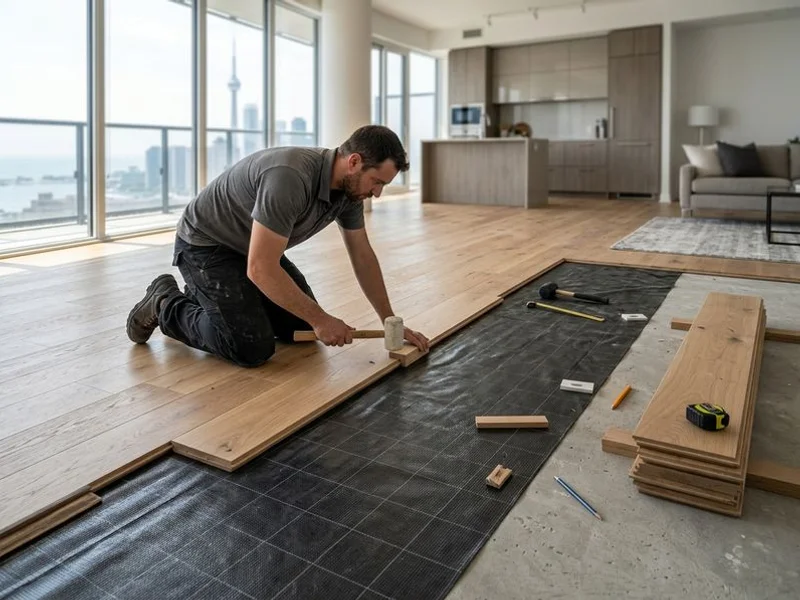
Hard Maple - the standard for GTA gyms and school corridors
Hard Maple at 1,450 lbf is the most common commercial hardwood specification in Toronto for spaces with high, sustained foot traffic. It is the standard species for GTA gymnasium floors, school corridors, and fitness studio environments for four reasons.
First, its hardness rating places it above White Oak and Red Oak - the two species most often specified for lighter commercial applications. That 90 lbf difference over White Oak is meaningful in a space with 500+ daily users.
Second, Hard Maple’s tight, consistent grain produces a surface that sands cleanly between recoat cycles. Commercial floors require maintenance recoating - typically every 1-3 years depending on traffic volume. Hard Maple’s grain structure allows a light scuff-sand and recoat without full sanding and finishing, which extends the floor’s service life significantly.
Third, Hard Maple accepts commercial hardener-concentration Bona Traffic HD without the adhesion variability that occurs with some open-grain species. The combination of Hard Maple and commercial-hardener Bona Traffic HD is the most durable floor system available for GTA commercial spaces.
Fourth, Hard Maple is domestically sourced and widely available in Ontario. Lead times are shorter than imported European species, and matching material for repairs is straightforward.
One note on staining Hard Maple: its density and tight grain make it resistant to stain penetration. Natural and clear finishes work reliably. Custom stain colours on Hard Maple require a pre-conditioner application and sample approval before the stain coat - budget an additional day and $1-2 per sq ft for stained Hard Maple work.
White Oak - the commercial restaurant and retail standard
White Oak at 1,360 lbf is the dominant species for Toronto restaurant and retail flooring. It is not the hardest option - but it is the most practical one for those environments.
White Oak’s open grain accepts stain evenly and consistently. In a restaurant environment, the floor colour and the way wear patterns develop over time matter to the business’s aesthetic. A floor that hides wear between annual recoat cycles is worth more than one that is marginally harder but shows every scuff. White Oak’s open grain provides exactly that coverage.
White Oak’s tan-to-grey colour variation also works with a wider range of interior design directions than Hard Maple’s pale, uniform appearance. In Yorkville boutiques, King West restaurants, and Liberty Village offices, White Oak engineered wide-plank is the current dominant specification.
For restaurant and retail applications, engineered White Oak - 5-ply or 7-ply construction, minimum 3mm wear layer - is specified over concrete slabs. The engineered construction handles the moisture cycling that concrete commercial slabs produce without the cupping and gapping that solid hardwood develops over time.
Brazilian Walnut (Ipe) - extreme traffic applications
Brazilian Walnut at 3,680 lbf is not a standard commercial flooring specification in most GTA environments. It is reserved for extreme-traffic applications where softer species would require annual replacement rather than recoating.
Commercial entry vestibules, loading dock transitions, and heavy industrial corridor sections are appropriate Ipe applications. The species is extremely dense, resistant to denting from wheeled loads, and handles abrasive particulate tracked in from exterior surfaces.
Ipe is difficult to work with compared to domestic species - it requires carbide-tipped tooling, special adhesives, and extended acclimatisation periods. Installation cost is 30-50% higher than standard commercial hardwood installation. It is the correct specification only when the alternative is replacing the floor every 1-2 years.
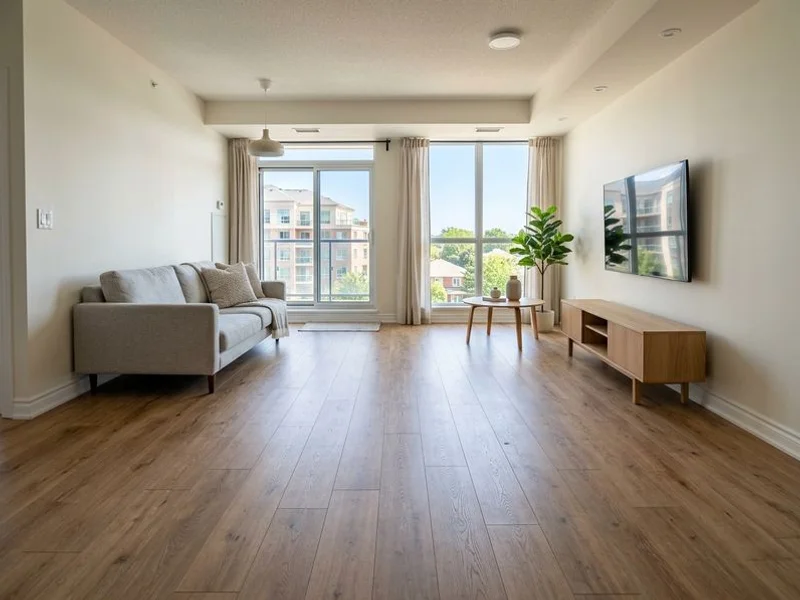
Engineered vs solid hardwood for commercial spaces
Concrete slabs are the predominant subfloor type in Toronto commercial spaces, and that single fact makes engineered hardwood the standard commercial construction type.
Solid hardwood cannot be glued to concrete. It requires either nail-down installation over a plywood subfloor assembly (which raises floor height by 1.5-2 inches and adds $3-6 per sq ft before any hardwood material or labour) or floating installation over a cork or foam underlay (not appropriate for commercial settings due to soft underfoot feel and insufficient load distribution).
Engineered hardwood with a minimum 3mm wear layer - and ideally 4mm or thicker for spaces where multiple recoat cycles are anticipated - is the correct specification for concrete slab commercial installations. The cross-grain plywood core resists expansion and contraction across the board width, which is the failure mode that ruins solid hardwood on concrete.
For second-floor commercial spaces with plywood subfloors, solid hardwood is technically viable. In practice, engineered hardwood is still often specified for its superior dimensional stability in commercial HVAC environments, where humidity levels fluctuate more than in residential settings.
Plank width and commercial stability
Narrower planks are more stable in commercial environments. Each board expands and contracts independently with humidity changes. Narrower boards produce smaller total movement per board, which means tighter gaps at peak humidity and less board-to-board differential movement over seasonal cycles.
Standard commercial plank widths run 3-4 inches for maximum stability. Wide-plank commercial installations at 5-7 inches are achievable with engineered construction and commercial HVAC humidity management, but they require explicit discussion of the building’s humidity envelope before specification.
GTA commercial buildings vary significantly in HVAC capacity. A tower office with precision climate control can support wide-plank engineered hardwood without issue. A converted industrial space with seasonal humidity swings is a different calculation.
Specialised commercial applications
ESD conductive flooring for data centres
Electronic discharge-sensitive environments - data centres, electronics manufacturing, server rooms - require flooring with controlled static dissipative properties. ESD-rated hardwood flooring systems are available in Ontario and meet ANSI/ESD S20.20 requirements for electrostatic discharge control. The installation includes a conductive adhesive layer and grounding connections that integrate with the building’s grounding system. Specification for ESD flooring requires a site survey to establish the required resistance range.
CFIA-compliant options for food service
Canadian Food Inspection Agency (CFIA) compliance requirements apply to flooring in or adjacent to food handling areas. For front-of-house restaurant and retail food spaces, sealed hardwood with a commercial-grade non-porous finish - Bona Traffic HD at commercial hardener concentration creates a sealed surface that meets most CFIA adjacency requirements. Full food preparation areas require non-porous, cleanable surfaces as defined by the Ontario Food Premises Regulation O. Reg. 562. Hardwood is appropriate for front-of-house; the specification boundary is established at the kitchen line.
Finish selection for high-traffic commercial floors
The finish system applied over the species determines how long the floor performs between recoat cycles. Two products dominate the Ontario commercial market.
Bona Traffic HD at commercial hardener concentration is the highest-durability waterborne finish available for commercial hardwood floors in Ontario. Applied in three coats over a commercial hardwood floor, it produces a scratch-resistant surface appropriate for restaurants, gyms, retail, and office environments. The commercial hardener concentration increases cross-link density beyond the residential formulation, translating directly to longer recoat intervals.
Bona Mega is appropriate for lighter commercial traffic - private offices, lower-footfall retail, executive suites - where the full commercial hardener concentration of Traffic HD is not required. It produces a slightly softer feel underfoot compared to Traffic HD and recoats more readily when the maintenance cycle arrives.
Both systems are waterborne, which means faster dry time between coats and lower VOC levels during the finish application period - relevant for off-hours commercial installs where the space must be usable by opening the next business day.