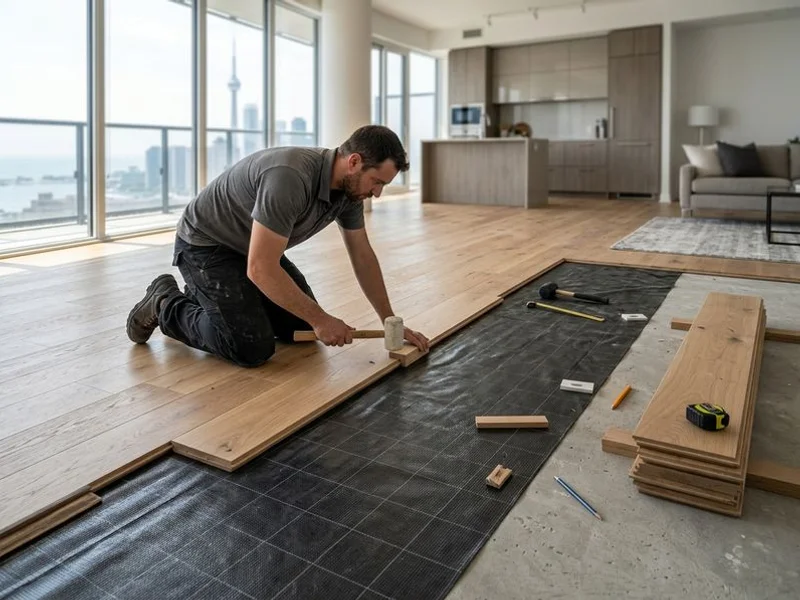
What commercial hardwood flooring actually costs in Ontario
Commercial hardwood flooring cost in Ontario is driven by variables that simply do not apply to residential work. Subfloor type, occupancy schedule, liability requirements, finish durability, and project scale all affect the final number in ways that make online price ranges difficult to apply without a site visit.
This guide breaks down the real 2026 cost structure for commercial hardwood flooring in Ontario - covering office, retail, and restaurant environments - so you can budget accurately before requesting quotes.
The core price range for commercial hardwood flooring installed in the GTA is $8-20 per square foot, depending on species, finish specification, site conditions, and scheduling. That spread is not vague - it maps to specific combinations explained below.
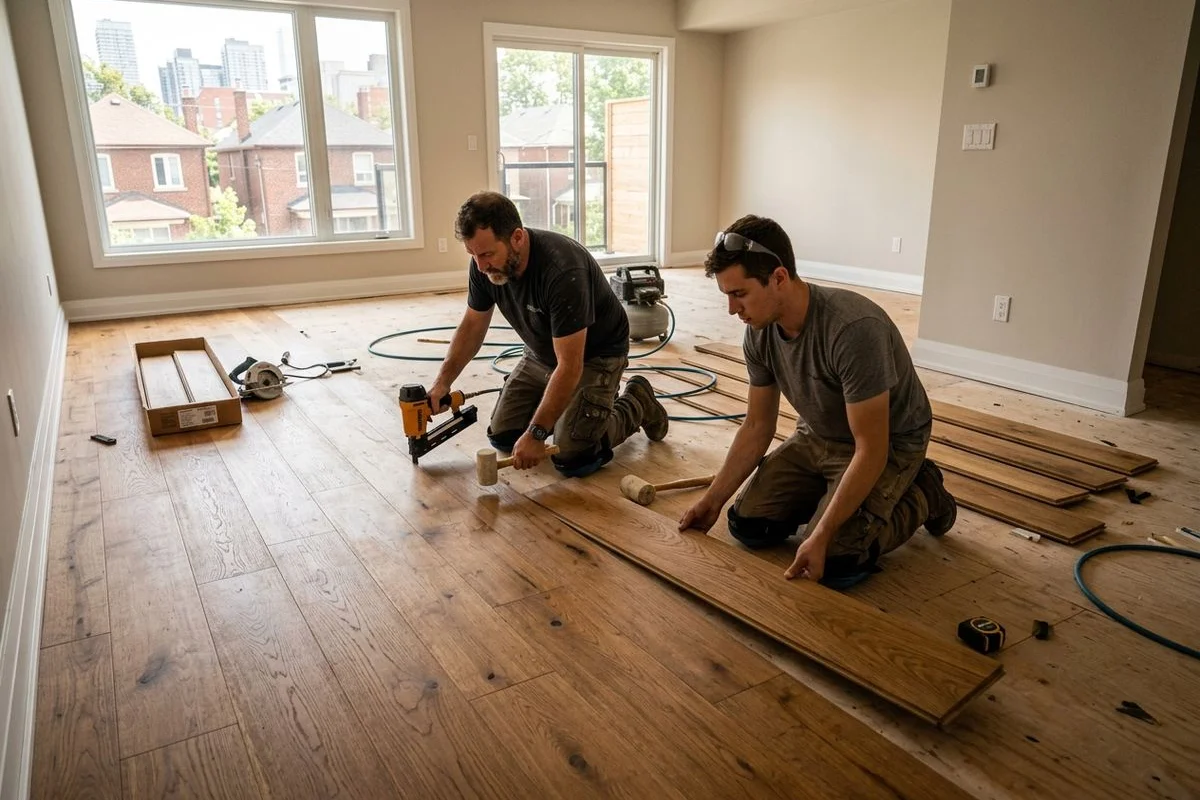
Why commercial costs more than residential
Four factors consistently push commercial hardwood flooring above residential pricing.
WSIB certification and $2M liability coverage are baseline requirements for most commercial properties. Landlords, property managers, and general contractors in Ontario require current WSIB clearance certificates and proof of commercial liability coverage before any crew enters a tenant space. These are non-negotiable requirements that add operating cost to every commercial job.
Commercial-grade finish systems cost more than residential-grade products. Bona Traffic HD with commercial hardener concentration - the standard specification for high-traffic commercial floors - runs $1-2 per sq ft more than the residential Bona Traffic HD formulation applied at standard concentration. The hardener raises the cross-link density of the finish, extending its service life significantly under commercial foot traffic.
ASTM F2170 moisture testing is required before any glue-down engineered hardwood installation over concrete. The test uses in-slab relative humidity probes installed and read over a minimum 72-hour period. Moisture testing runs $300-600 per project and is a hard requirement - not optional - for engineered hardwood over commercial concrete slabs.
Off-hours scheduling is required whenever a business cannot shut down for installation. Evening and weekend work carries a 10-20% labour premium over standard daytime rates. For a restaurant that can only be accessed Sunday night through Monday morning, the full off-hours premium applies to every crew hour.
Price by commercial environment type
Office spaces - $8-14 per sq ft installed
Office environments are the most straightforward commercial hardwood application. Traffic is predictable, the subfloor is usually concrete, and work can often be scheduled outside business hours without extreme time pressure.
Typical specification for a Toronto office: engineered White Oak or Hard Maple, 5” wide plank, glue-down over concrete, Bona Traffic HD commercial finish. Moisture testing and prep included.
Projects under 2,500 sq ft carry minimum mobilisation charges. Projects 2,500-10,000 sq ft typically achieve the best per-square-foot rate because crew and equipment are fully utilised across multiple days.
HST is invoiced separately on all commercial projects, and written invoices are provided for CRA and property management records.
Retail spaces - $10-16 per sq ft installed
Retail flooring cost is driven upward by two factors: display fixture weight and the need for phased installation around operating hours.
Retail environments cannot always close for a full install. Phased scheduling - installing in sections while portions of the store remain open - requires additional planning, temporary transitions, and dust management between active retail areas and work zones. The scheduling complexity adds to total project cost.
Finish specification for retail typically steps up to Bona Traffic HD with full commercial hardener concentration. A busy Toronto retail floor on Queen West or King Street West can see 500-1,000 customers per day. At that traffic volume, commercial hardener concentration is not optional.
Restaurant spaces - $12-20 per sq ft installed
Restaurant hardwood flooring is the most demanding commercial application and commands the highest installed cost. Three factors drive the premium.
Moisture exposure near service areas, bars, and kitchen pass-throughs is significant. Engineered hardwood is specified in all restaurant installations - typically with a 4mm or thicker wear layer over a plywood or multi-ply core that handles the moisture cycling without cupping or gapping.
CFIA compliance requirements apply to any hardwood flooring installed in or adjacent to food preparation areas. Species selection, finish products, and installation methods must all be assessed for compliance.
Off-hours installation is typically mandatory. Most Toronto restaurants cannot close for a multi-day flooring install. Sunday night through Monday morning installations are common, with the crew working from close to open. This scheduling constraint is real - not a negotiating point - and the 10-20% off-hours premium reflects the genuine cost of running a crew at night.
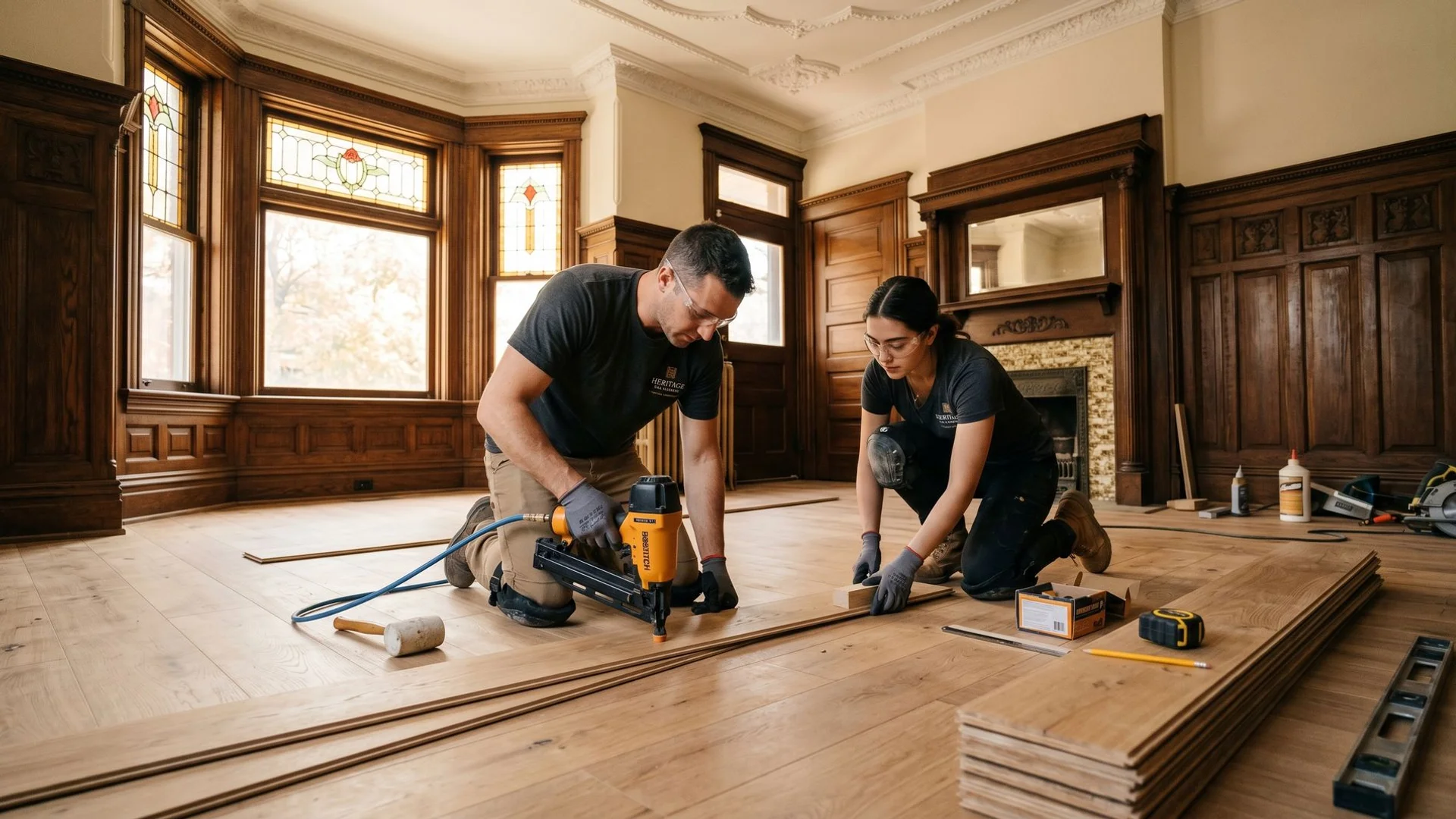
Engineered vs solid hardwood for commercial - the concrete slab question
Most Toronto commercial spaces sit on concrete slabs. That single fact determines the flooring construction type.
Solid hardwood cannot be glued directly to concrete. The moisture vapour transmission through a concrete slab - even a well-cured one - creates a moisture gradient that causes solid wood to cup, gap, and buckle. The standard ASTM F2170 test must confirm relative humidity below 80% RH at depth before any wood flooring installation proceeds. If moisture levels exceed that threshold, a moisture mitigation system must be installed first.
Engineered hardwood is constructed for concrete subfloor installation. A quality commercial-grade engineered product - 5-ply or 7-ply cross-grain construction, minimum 3mm wear layer - handles the moisture cycling that concrete subfloors produce over seasons. The cross-grain construction resists dimensional movement across the plank width, which is where solid hardwood fails on concrete.
For commercial spaces with existing plywood subfloors (second-floor offices, wood-frame buildings), solid hardwood is viable, though engineered is still often specified for its superior dimensional stability in climate-controlled commercial environments.
Bona Traffic HD commercial hardener - what the finish upgrade costs
The finish system on a commercial hardwood floor is not interchangeable with residential-grade products. Bona Traffic HD is the industry-standard waterborne commercial finish in Ontario, but the commercial application uses a higher hardener concentration than the residential formulation.
The commercial hardener concentration increases cross-link density in the cured finish, which directly translates to scratch and abrasion resistance under continuous foot traffic. At standard residential concentration, Bona Traffic HD is appropriate for high-end residential and light commercial use. At commercial concentration, it is the correct specification for restaurant, retail, and office environments with sustained daily traffic.
The premium for commercial hardener concentration runs $1-2 per sq ft over the base finish cost. On a 3,000 sq ft office project, that is $3,000-6,000 - a meaningful number. It is also the difference between a floor that recoats annually and one that holds for 3-5 years between recoat cycles.
Typical project sizes and cost ranges
| Project type | Typical sq ft | Installed cost range | Notes |
|---|---|---|---|
| Boutique retail / small office | 500-1,500 | $6,000-24,000 | Minimum mobilisation may apply below 1,000 sq ft |
| Mid-size restaurant or office | 1,500-4,000 | $15,000-64,000 | Off-hours premium likely for restaurant |
| Full-floor corporate fitout | 4,000-10,000 | $40,000-160,000 | Fixed-price quote requires full site walk |
| Multi-space retail group | 10,000+ | By quote only | Phased scheduling and staging plan required |
These ranges assume GTA labour rates, engineered hardwood specification on concrete, and Bona Traffic HD commercial finish. Site-specific conditions - elevator access, loading dock restrictions, HVAC sequencing, phased occupancy - affect the final number and are captured in the site walk.
The fixed-price quote process for commercial projects
Commercial hardwood flooring quotes from Toronto Quality Wood Flooring require a site walk before any price is provided. The site visit establishes:
- Subfloor type, condition, and current moisture readings
- Precise square footage including obstacles, columns, and exclusions
- Scheduling constraints - operating hours, fire safety requirements, elevator booking procedures
- Finish specification based on traffic type and volume
- Access requirements for material delivery and crew parking
A written fixed-price quote is provided within 48 hours of the site visit. For commercial hardwood flooring projects, the quote separates material, labour, moisture testing, finish, and any identified subfloor preparation into line items - so you can compare proposals from multiple contractors on a consistent basis.
WSIB clearance certificates and proof of $2M commercial liability are included with every proposal. HST is invoiced separately on all commercial work.