
Hardwood flooring for Toronto restaurants and retail - the real-world guide
Hardwood flooring is one of the most specified materials in Toronto restaurant and retail interiors. The warmth it adds to a dining room or boutique is commercially valuable - it communicates quality to customers in a way that resilient vinyl or polished concrete does not. That value comes with real operational requirements that any Toronto restaurateur or retailer needs to understand before the project starts.
This guide covers the practical decisions: species, finish, scheduling, CFIA considerations, maintenance cycles, and the specific challenges of Toronto’s most active restaurant and retail neighbourhoods. For a broader breakdown of pricing, see our commercial hardwood flooring service page.
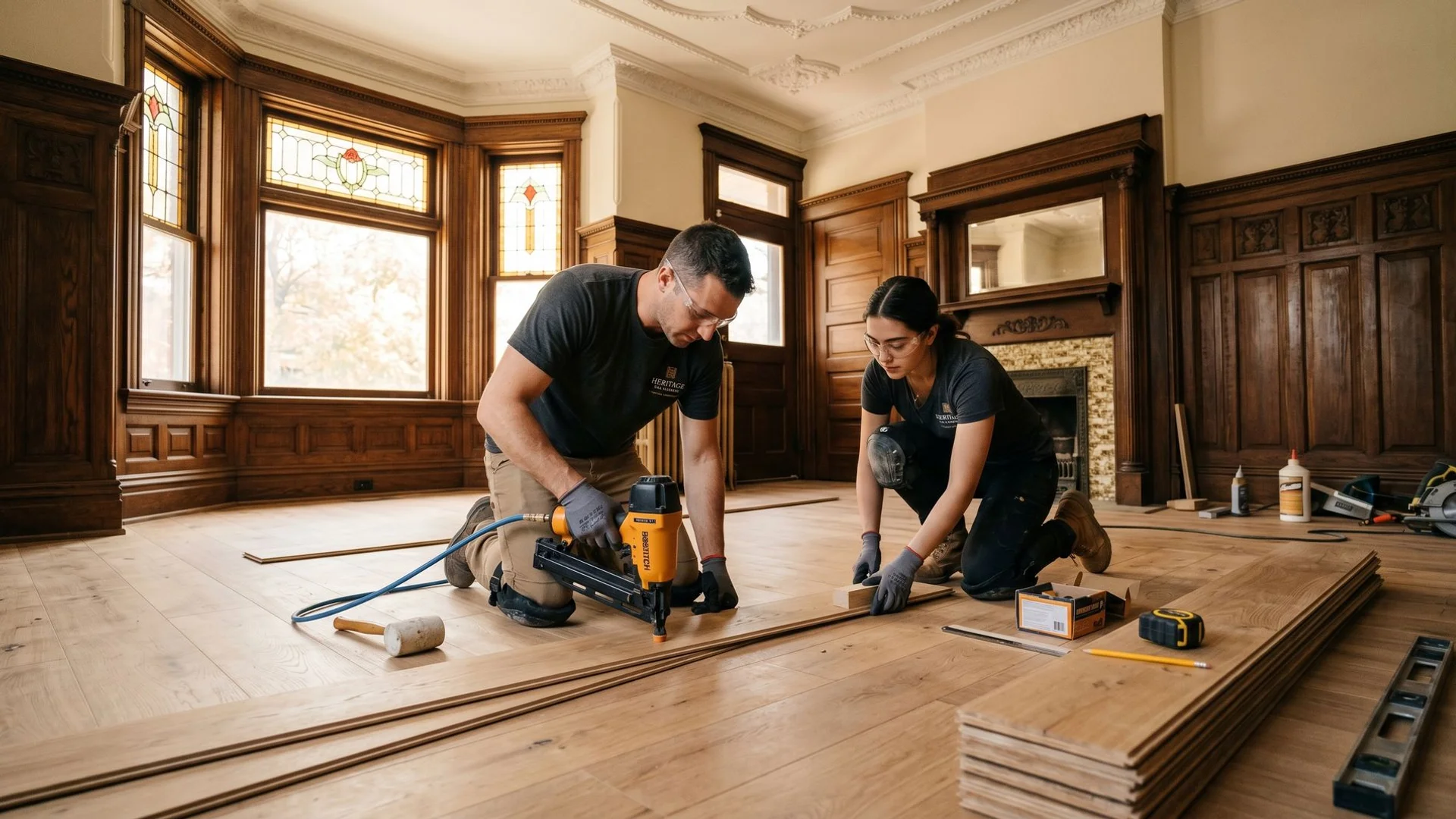
Restaurant-specific hardwood flooring considerations
Moisture from spills and service traffic
Restaurants are the most moisture-intensive commercial hardwood application. Spills from water service, bar operations, and passing food traffic are constant. The hardwood specification for a restaurant must account for this from the start - not as an afterthought.
Engineered hardwood is required in all Toronto restaurant installations. Most restaurant spaces sit on concrete slabs, which makes engineered construction the structural necessity. Beyond the subfloor consideration, engineered hardwood’s dimensional stability under humidity cycling handles the moisture patterns of restaurant service better than solid hardwood would.
The minimum engineered specification for a restaurant is a 5-ply or 7-ply construction with a 3mm or thicker wear layer. A thicker wear layer - 4mm is common in restaurant specs - allows more recoat cycles before the floor requires replacement, extending the total service life of the installation.
Kitchen proximity and CFIA compliance
Ontario’s Food Premises Regulation (O. Reg. 562) establishes surface requirements for food handling and preparation areas. Hardwood flooring is appropriate for restaurant front-of-house spaces - dining rooms, bar areas, host stands, and waiting areas. The specification boundary is the kitchen line.
For any restaurant with an open kitchen concept or a pass-through window where food preparation and dining areas share a continuous floor surface, CFIA compliance must be reviewed before finalising the flooring specification. In practice, most Toronto restaurant installations treat the kitchen pass-through line as the hard boundary for hardwood, transitioning to tile, sealed concrete, or vinyl at the kitchen entry point.
If your restaurant’s concept requires hardwood up to or past the pass-through, a CFIA consultation prior to installation is the correct sequence. Toronto Quality Wood Flooring can provide species and finish documentation to support that consultation.
Off-hours installation - Sunday night through Monday morning
Restaurant hardwood flooring installation in Toronto is almost always an off-hours project. The adhesive cure time for glue-down engineered hardwood is 24 hours minimum before foot traffic. Three coats of Bona Traffic HD require dry time between coats and final cure time before the floor is ready for service.
The practical result: most Toronto restaurant installations are scheduled for Sunday night close through Monday morning. The crew arrives at 11pm-midnight after the last service, installs the floor, applies the finish system, and exits before the restaurant opens Tuesday. For larger spaces that require multiple nights, the schedule extends to a multi-evening sequence with sections cordoned off between install nights.
Off-hours scheduling carries a 10-20% labour premium over standard daytime rates. This is not negotiable - the premium reflects real crew operating costs for night work. It is also not optional for most restaurants. A restaurant that closes for two full business days for a flooring install loses revenue that likely exceeds the scheduling premium several times over.
Species recommendation for restaurants - White Oak
White Oak is the standard restaurant hardwood specification in Toronto for two reasons: colour variation and stain behaviour.
White Oak’s open grain accepts stain evenly across the board, which allows restaurateurs to select a floor colour that fits the interior concept. More importantly, White Oak’s colour variation and open grain pattern hide wear. A restaurant floor between annual recoat cycles develops wear patterns near the bar, the host stand, and the paths between tables. White Oak’s grain and colour variation absorb those patterns visually in a way that pale, uniform Hard Maple does not.
At 1,360 lbf on the Janka hardness scale, White Oak handles restaurant foot traffic reliably. It is not the hardest species available, but it is the most practical combination of hardness, workability, and aesthetics for the GTA restaurant market.
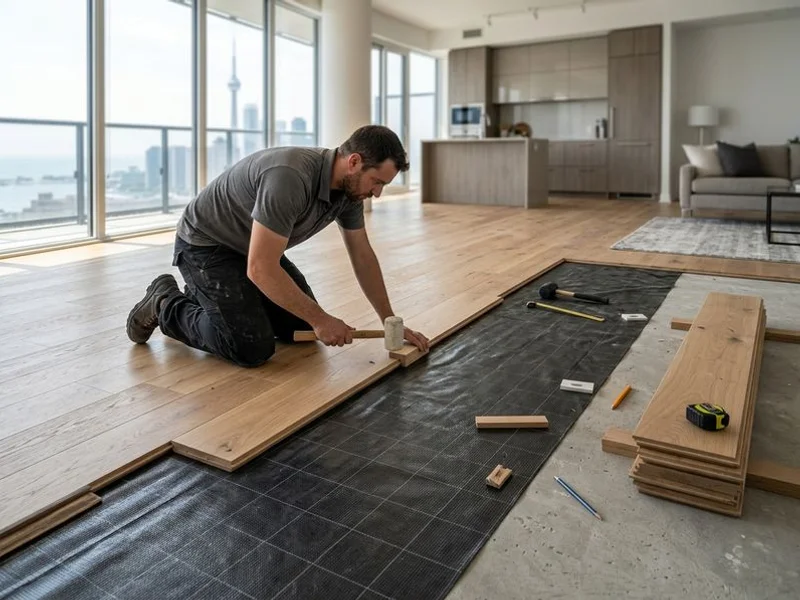
Retail-specific hardwood flooring considerations
Customer foot traffic patterns and display fixture weight
Retail hardwood flooring faces different stresses than restaurant flooring. Foot traffic patterns are less predictable - customers move throughout the store rather than along fixed service paths. Display fixtures concentrate point loads in specific areas. Wheeled equipment for restocking creates rolling abrasion.
Species selection for retail starts with traffic volume. A boutique on Yorkville’s Bloor Street West with 50-100 customers per day has different requirements than a destination retail store in the Distillery District processing 500+ visitors on a Saturday. The species and finish specification should reflect the actual volume, not a conservative assumption.
For high-volume retail, Hard Maple at 1,450 lbf is the correct species specification. Its hardness handles rolling loads from display fixtures and high foot traffic without the denting that lower-hardness species would show under the same conditions.
For lower-volume high-end retail, White Oak is appropriate and preferred - its aesthetic range is broader and its stain acceptance allows custom colour specifications that match the store’s interior design more precisely.
Open during installation - phased scheduling
Unlike most restaurants, some retail spaces can remain partially open during flooring installation. A boutique can cordon off a section of the store, install the floor in that section, allow it to cure, and then move to the next section while reopening the completed area.
Phased retail installation is more expensive than a single-pass install - temporary transitions, additional setup and teardown between sections, and the scheduling complexity of coordinating around operating hours all add cost. The trade-off is continuous revenue during the installation period.
Whether phased or full-closure installation is appropriate depends on the store’s weekly revenue and the project’s total scope. A 2,000 sq ft boutique that cannot close for three days may find that the revenue preserved during a phased install more than covers the scheduling premium.
Species for retail - Hard Maple for high-volume, White Oak for design-forward
Hard Maple is the top specification for high-traffic Toronto retail floors. Its 1,450 lbf Janka rating handles concentrated foot traffic and rolling display fixture loads. Its pale, consistent appearance works well with modern minimalist retail interiors.
White Oak is the specification for design-forward retail where interior colour palettes and material warmth are commercial differentiators. Yorkville boutiques, King West lifestyle retail, and Liberty Village concept stores routinely specify White Oak engineered wide-plank with custom stain - the result is a floor that is part of the brand identity rather than just the subfloor.
Finish - Bona Traffic HD with commercial hardener
Both restaurant and retail hardwood floors in the GTA are finished with Bona Traffic HD at commercial hardener concentration. The commercial hardener formulation increases the cross-link density of the cured finish, which translates to scratch and stain resistance appropriate for sustained commercial use.
The commercial hardener concentration is not the same product as the residential Bona Traffic HD application. The distinction matters practically - a residential-concentration finish on a restaurant or retail floor will show finish wear significantly faster than the commercial specification. The premium for commercial hardener concentration runs $1-2 per sq ft over the base finish cost.
A three-coat Bona Traffic HD system applied at commercial hardener concentration is the correct specification for Toronto restaurant and retail floors. Two coats is the minimum for commercial use; three coats is the standard that provides the wear depth needed to support maintenance recoating rather than full resanding when the maintenance cycle arrives.
Maintenance and recoating schedule
Restaurant and retail hardwood floors operate on different maintenance timelines.
Restaurant recoating: annually. A busy Toronto restaurant floor - 200-300 covers per night, open six nights a week - requires annual recoating to maintain the sealed surface. Annual recoating is a light scuff-sand and one coat of Bona Traffic HD, performed in an off-hours window. It takes one evening and is far less disruptive than a full refinish. Skipping annual recoating allows finish wear to progress to bare wood, which then requires full sanding and three-coat refinishing at considerably higher cost.
Retail recoating: every 2-3 years. Lower sustained traffic means the finish holds longer. The recoating schedule should be adjusted based on actual wear observations - a high-volume Distillery District destination store may need annual recoating, while a low-traffic Yorkville boutique may comfortably extend to three years between recoats.
Toronto neighbourhoods commonly served for restaurant and retail flooring
Toronto Quality Wood Flooring completes restaurant and retail hardwood flooring projects throughout the GTA. Frequently served commercial districts include:
- Queen West and Ossington - the highest density of restaurant and boutique retail projects in the city; off-hours scheduling is standard for all Queen West restaurant work
- King West - restaurant row and tech-corridor office retail; large floor plates in converted industrial buildings
- Yorkville - high-end retail and restaurant interiors; White Oak engineered wide-plank is the dominant specification
- Liberty Village - mixed restaurant and office retail; newer concrete construction throughout
- Distillery District - historic buildings with varied subfloor conditions; restoration of original boards alongside new hardwood is common
- Leslieville and Gerrard East - growing restaurant district with tight scheduling windows and active weekend traffic
ESA permits for commercial electrical work adjacent to flooring projects are coordinated through the general contractor or property manager. HST invoicing is standard on all commercial restaurant and retail flooring projects, with written fixed-price quotes provided within 48 hours of the site walk.
WSIB-certified crews and $2M commercial liability coverage are included with every Toronto Quality Wood Flooring commercial project. Certificates are provided with the project proposal.